DD Provider Onboarding Program

Snapshot
This blended learning experience was produced for a small disability support and intervention team. It’s comprised of an online self-paced preboarding course, an onboarding workbook, an ILT program, job aids, and a continuing professional development plan. The preboarding course was created in Articulate Rise. The video to the right shows a few the lessons or you can try out the course HERE.
Challenge: Create an effective training program for highly ambiguous and varied roles within in a high turnover field.
Audience: Community Support Workers (CSWs) and Behavioral Interventionists (BIs) serving a cognitively disabled individual with extensive needs. CSWs typically have not completed any formal education while BIs have graduate degrees and hours of behavioral training. Digital skills ranged from none to intermediate level.
Strategy: Built a comprehensive learning experience comprised of pre-boarding videos, an on-site training program, retention support documents, and ongoing professional development.
Impact: Team members felt more confident and capable in their roles, completed tasks more accurately, and better supported the individual to achieve his goals.
Process
Analysis & Design
With an accelerated timeline (a functional first iteration needing to be ready within one week), I quickly met with the current team and discussed the instructional problem, learner personas, and their needs. There was not time to conduct full analyses or to produce new topical videos or job aids, so we worked with the content and tools they had on-hand (with future plans to revise the videos and resources).
It was determined that a blended learning experience was optimal to: 1) avoid cognitive overload, 2) combat the forgetting curve, 3) reduce the time demand on trainers, and 4) ensure learning consistency.
There was a long-standing issue of training inconsistency, since each trainer found different topics to be most relevant and the client’s behaviors often influenced the day’s activities. By covering all of the key topics in an online preboarding course, learners would be through the “Understand” level of Bloom’s Taxonomy and ready for the “Apply” level when arriving on-site.
I determined the topics for each part of the program (e.g., course, ILT, workbook) by interviewing all current trainers and recent learners. From there, the team discussed which topics were best addressed in-person and which should be covered in preboarding. It was decided that a workbook with checklists would be helpful to ensure that all topics were adequately covered (since ILT is delivered while the trainer is also caring for the client). The workbook also provided space for the individual’s notes and an organized way to track their learning journey.
Trainers needed a way to know which topics they should cover that day, since they could be the first, second, or third person guiding the new hire. Sometimes, they would need to start with the basics and other times they needed to avoid redundancy. Without a way to know what topics were covered by other trainers, they had to repeatedly ask the new hire what they had already learned. There was not time or money for a Train the Trainer course, so a facilitator’s guide was selected instead.
Development
Implementation & Evaluation
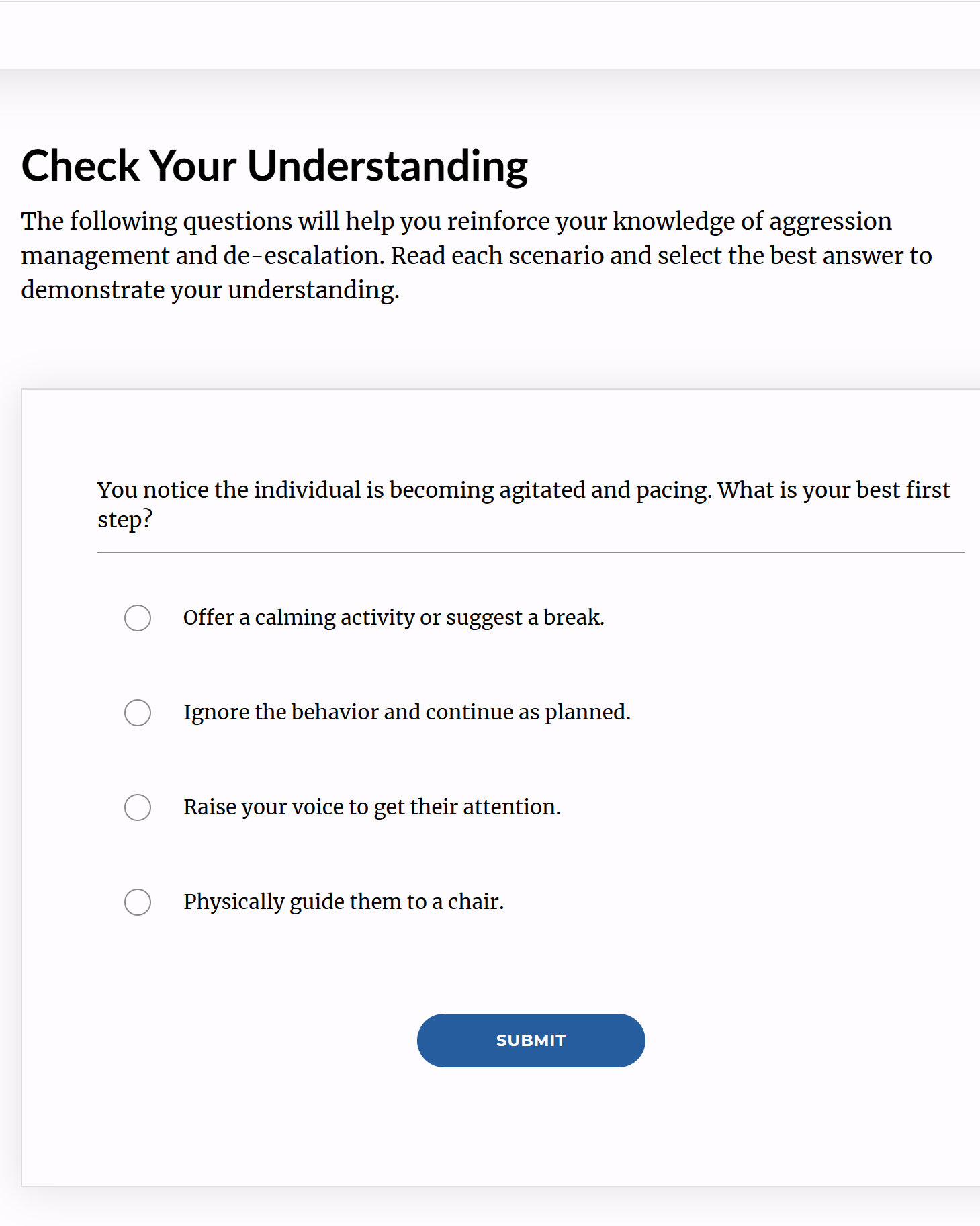
The preboarding course was developed in Articulate Rise, due to the limited amount of development time and need for integrated multimedia and assessments. I leveraged Rise’s Artificial Intelligence (AI) features to flesh out each preboarding course topic and to suggest interactive elements that aligned with the content.
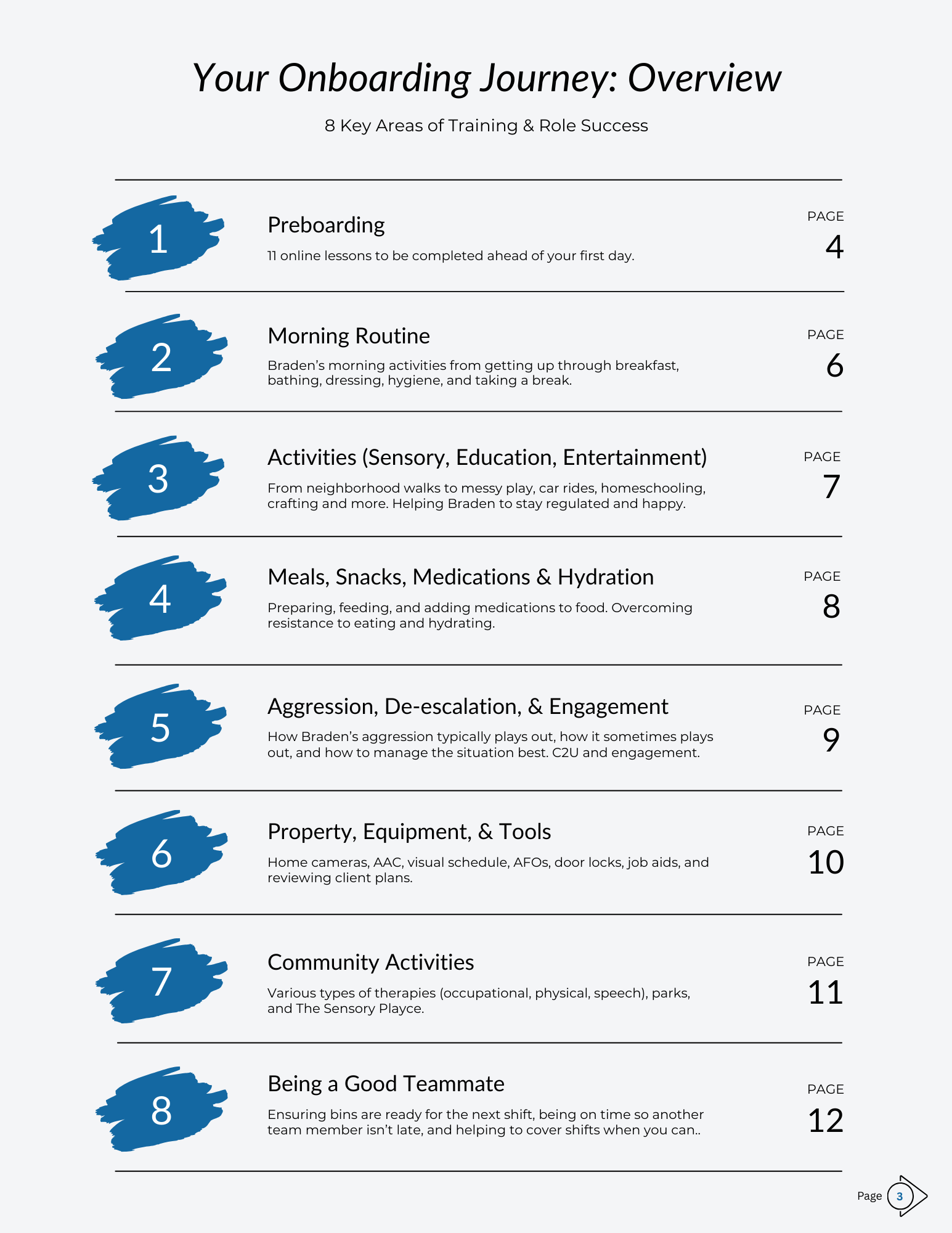
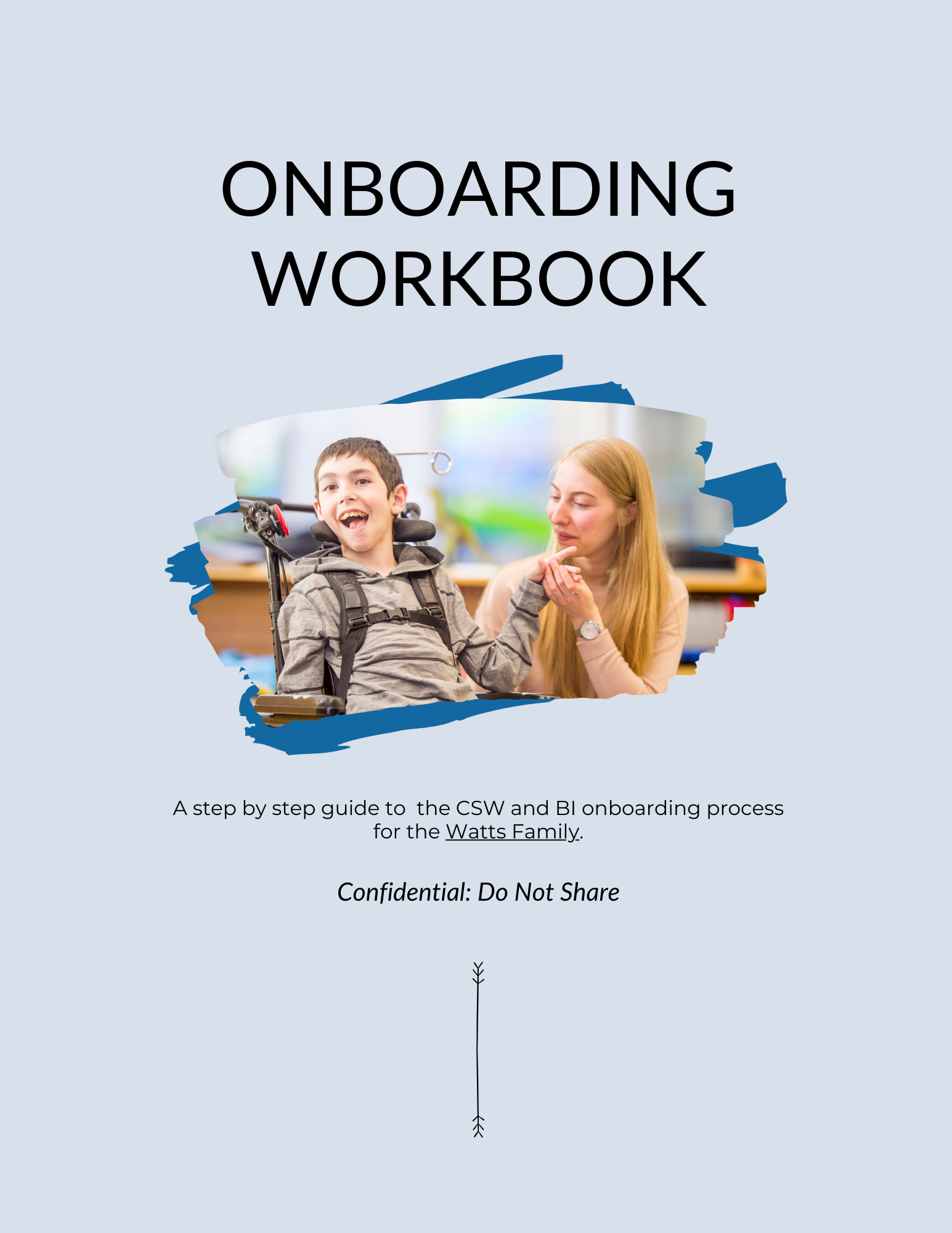
I used Canva to create the workbook and facilitator’s guide (for the ILT segment). To the right are a couple pages of the 13-page workbook.
It was decided that ongoing professional development would be delivered through team meetings (with a behavioral supervisor) and individual meetings with the on-site employer.
Learners needed to be able to access the preboarding course from any location (e.g., work, home, mobile device, library) and the client did not have the budget for an LMS, so the Rise course was hosted via Google Cloud and the employer’s website. New hires are sent a link to the course and cannot proceed to subsequent lessons without successfully passing the current lesson assessments. This ensures that learners have mastered the key concepts of each lesson.
While this option will not provide digital footprint data (like learner pace, attempt patterns, rewatch rates, stall points, scroll depth, or click tracking), course efficacy will be evaluated by the on-site trainers as they see how prepared new hires are on their first day. This data will be tracked and used to determine future iterations of the preboarding course.
Articulate Rise
Articulate 360
Google Console
Canva
Iterative Design
Skills Used
Curriculum Development
E-Learning
Empathetic Design
Bloom’s Taxonomy
Gagne’s Nine Events
Rapid Development
Process Mapping
SME Interviews
Webpage Development
Accessibility