

HCSP Foundations Companion
A Multi-tiered Compliance & Performance Support Curriculum for Direct Support Professionals
Limited view to protect proprietary information.
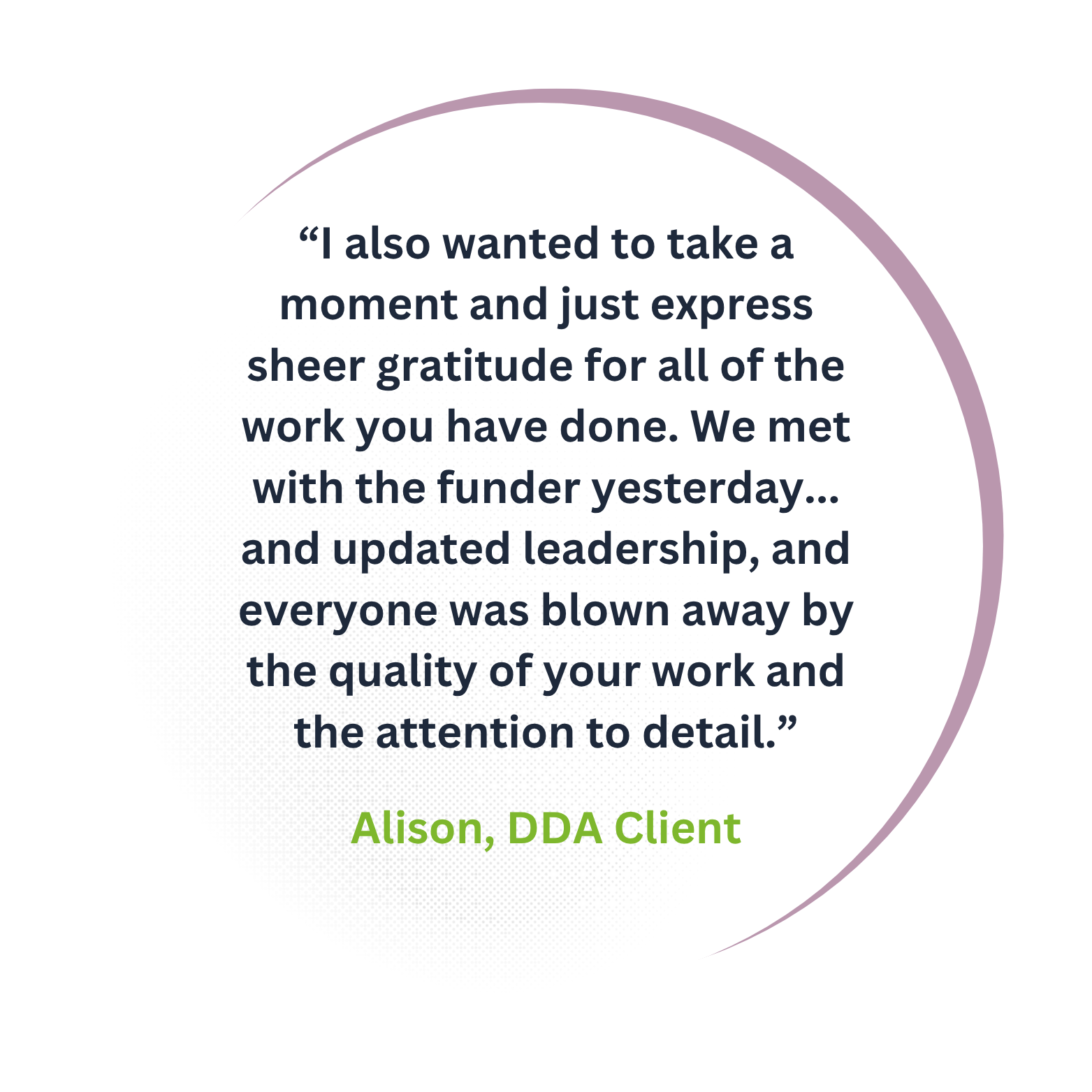
Snapshot
I designed and authored a comprehensive, multi-module training program for a Developmental Disability Agency (DDA), addressing critical knowledge gaps in direct support, client advocacy, and regulatory compliance that emerged as a result of a statewide administrative rule change. Combining a PowerPoint presentation deck, a Facilitator Guide, a Learner Workbook, and a custom English Language Learner (ELL) Guide, the curriculum translates complex administrative regulations into actionable, high-impact instruction. Built around Universal Design for Learning (UDL) principles and a custom plain-language framework, the materials leverage adult learning theory, scaffolded learning, real-world scenario sandboxes, and behavioral scripts to empower diverse learners. Every asset strictly aligns with IAC Rule 460, CARF standards, and WCAG digital accessibility guidelines.
Challenge: A statewide administrative rule change created critical compliance gaps across agencies, requiring a need to rapidly develop a new direct support training program.
Audience: Direct Support Professionals (DSPs) including job coaches, behavioral interventionists, van drivers, and direct support workers. Many of these individuals are English Language Learners who require clear, highly scannable, low-cognitive-load instruction to navigate complex compliance rules in the workplace.
Strategy: Applied a multi-tiered Instructional Design strategy centered on accessibility, performance support, and compliance mapping. This included a UDL-focused, 5-part (external) or 6-part (internal) synchronized curriculum offering multiple means of engagement, representation, and expression. I engineered a custom ELL guide and used language anchored at a 6th to 8th grade reading level, structured sentence frames, plain-English definitions, and active-voice guidance to lower the language barrier for non-native English speakers. The course also includes visual anchoring, contrastive modeling, behavioral performance support, and narrative case studies. The result was a multi-asset curriculum (Slide Deck, Facilitator Guide, Learner Workbook, and ELL Support Guide).
Impact: Empowered new support professionals to confidently bridge the gap between abstract state regulations and daily, hands-on shift execution - standardizing documentation, eliminating compliance errors, protecting client autonomy, and establishing an accessible, agency-wide training standard. Created a scalable, high-value intellectual property asset that enables the host agency to generate ongoing revenue by licensing the complete training framework to other DDAs navigating these same new compliance mandates.
Process
Front-End Analysis & Curriculum Audit
In the Analysis phase, I conducted a Needs Analysis, a Learner Analysis, a Front-End Analysis, a Contextual Inquiry, and a Subject Matter Audit.
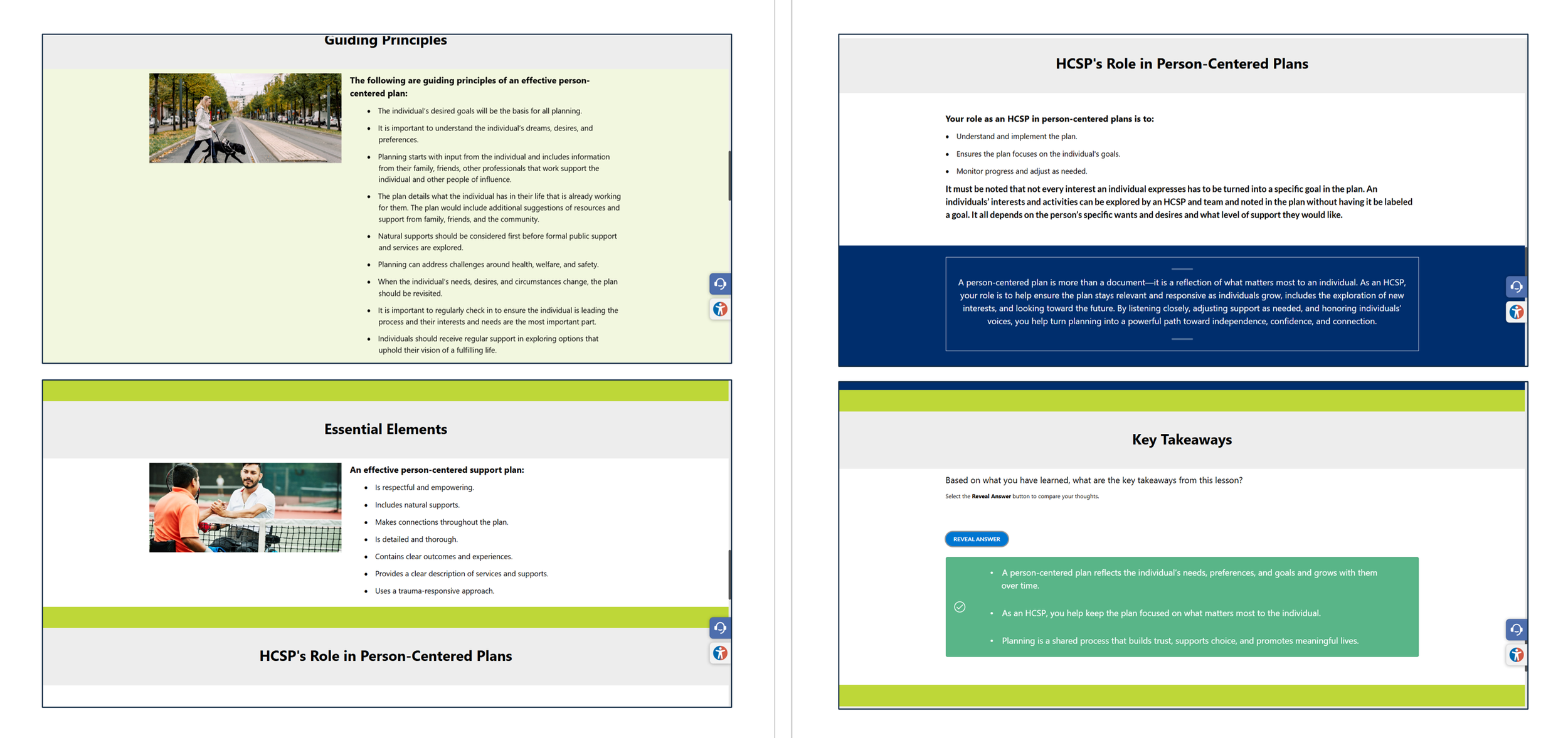
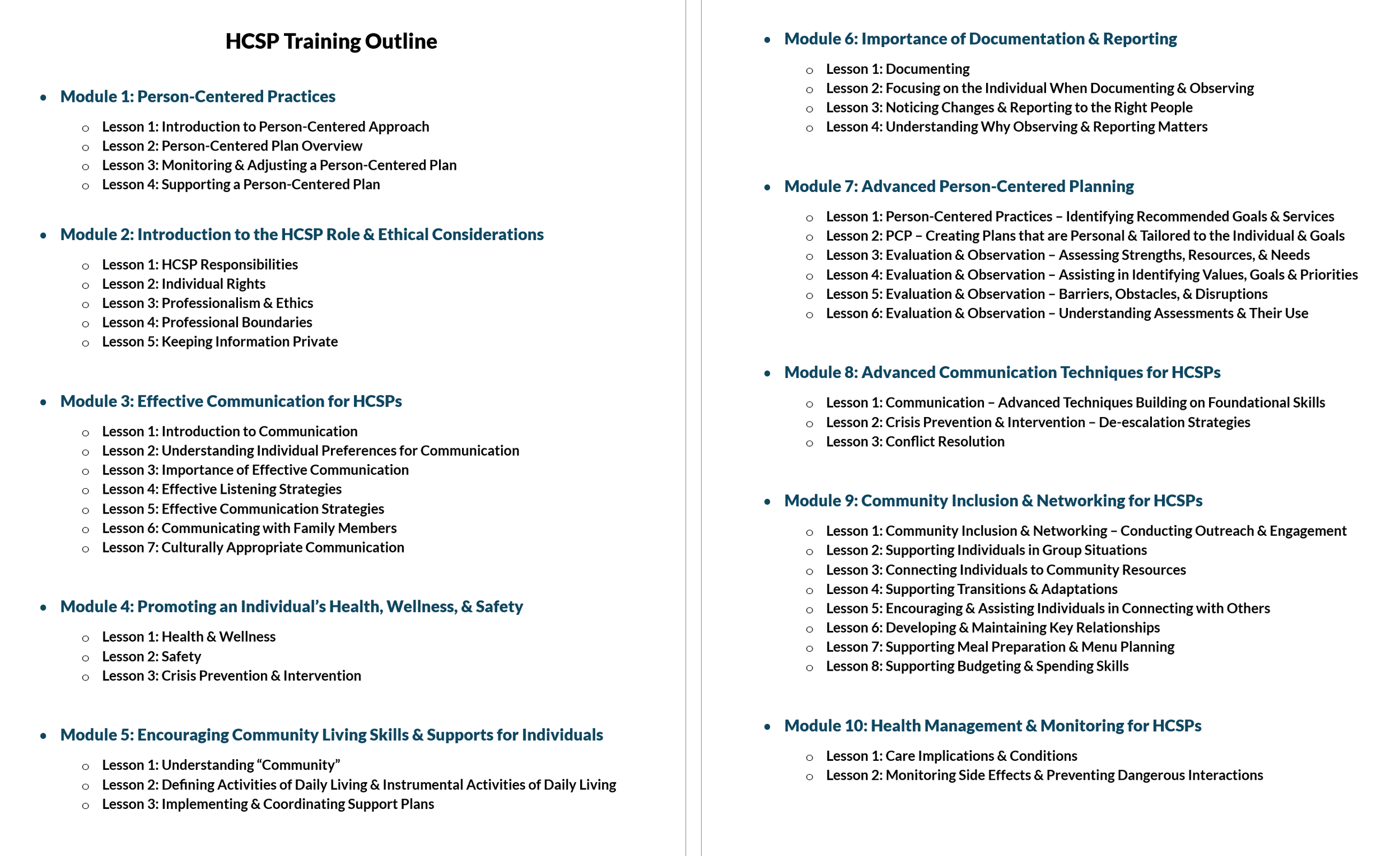
I formally reviewed and documented the state’s HCSP Foundations course, the precursor to the project course. While taking this course, I created an outline of the curriculum and took screenshots (so I could remember the details, if needed).
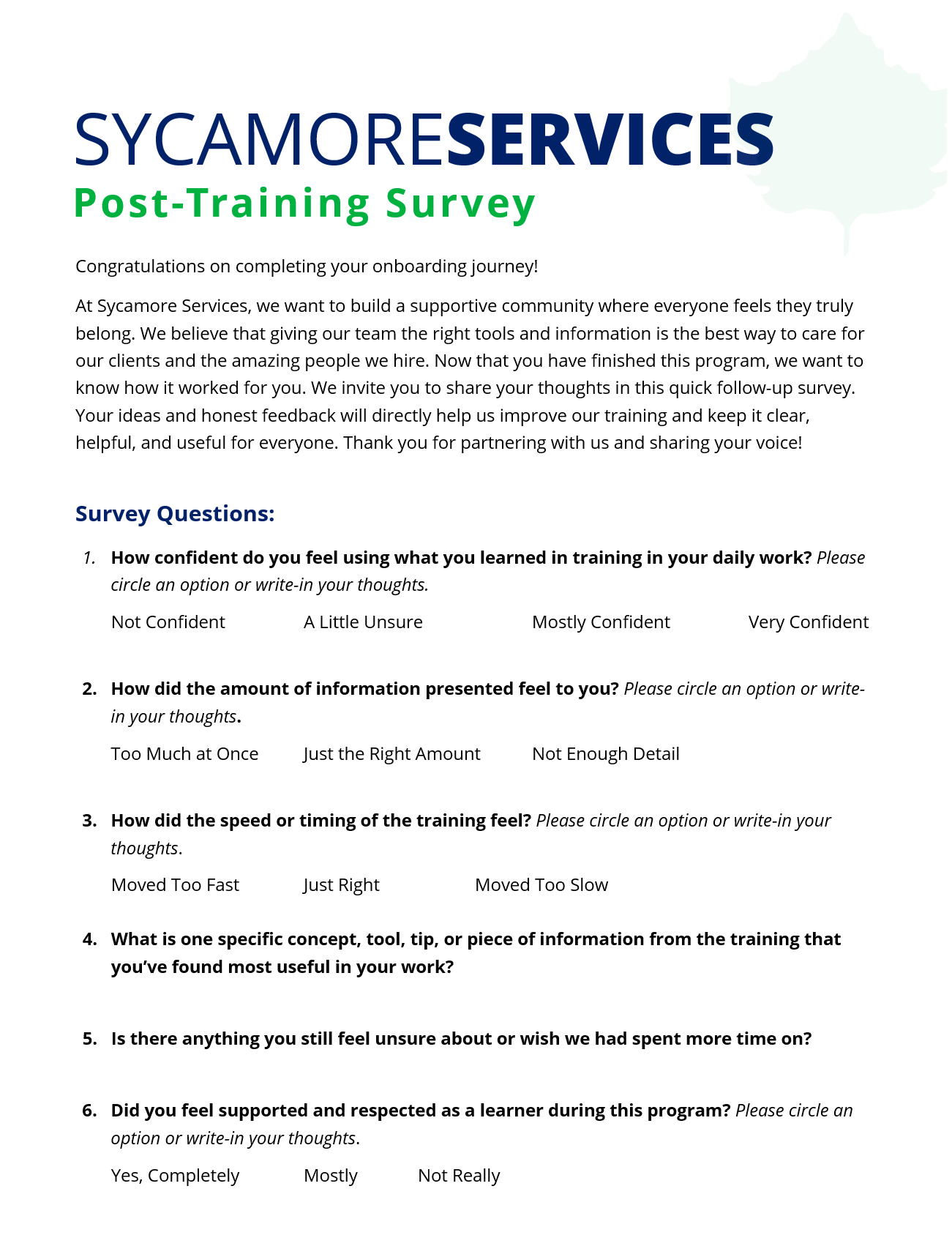
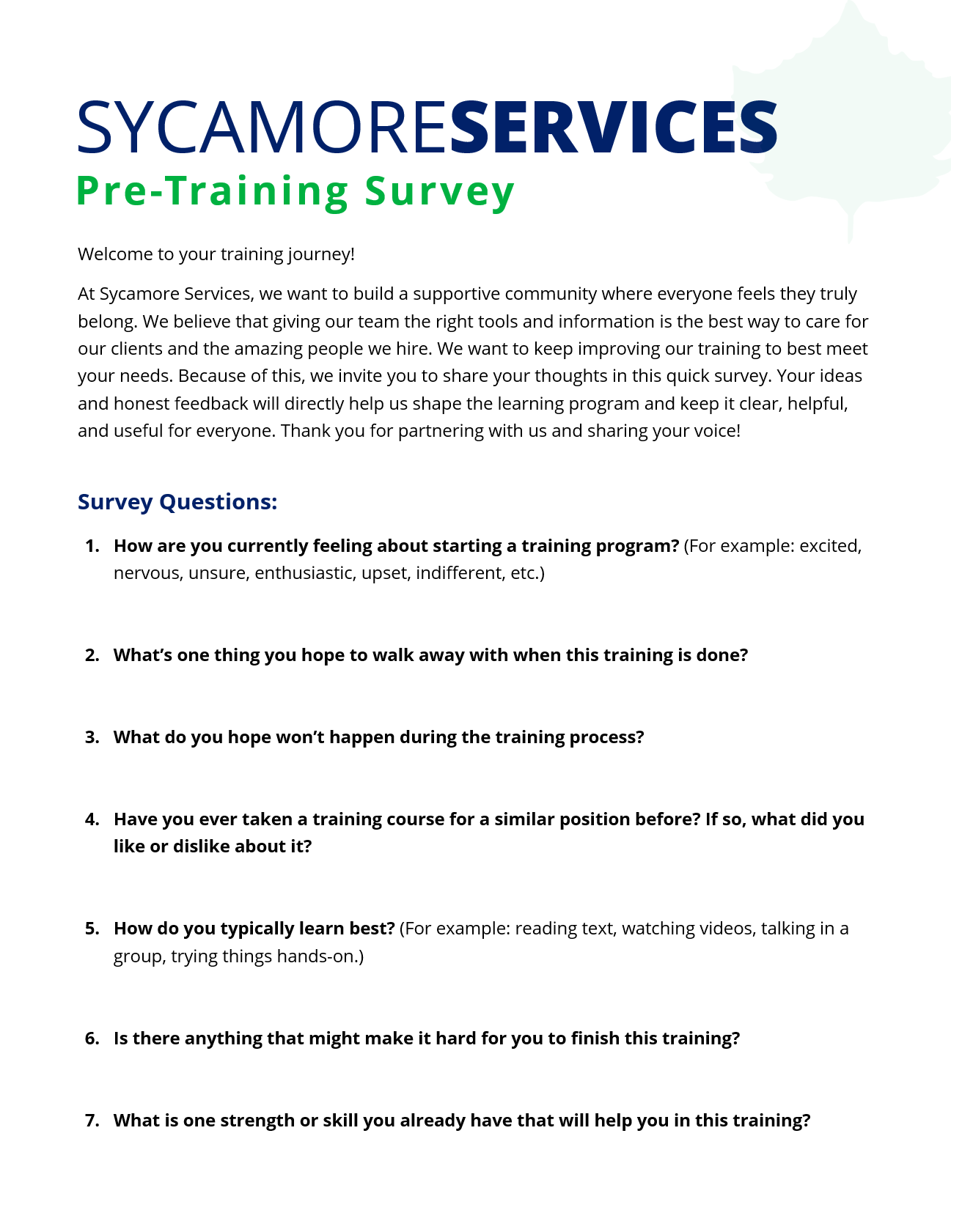
The client was not interested in personas and did not have training data available for review. To understand the current state of training and the learner population better, I quickly produced pre-training and post-training surveys ahead of the next training cycle. The agency’s facilitator asked several learners to complete these surveys, which provided valuable insights.
A few key takeaways were:
Concerns about training feeling “rushed” through training.
A heavy preference for videos and “hands-on” activities.
Fear about “not understanding it all” (from an ELL learner).
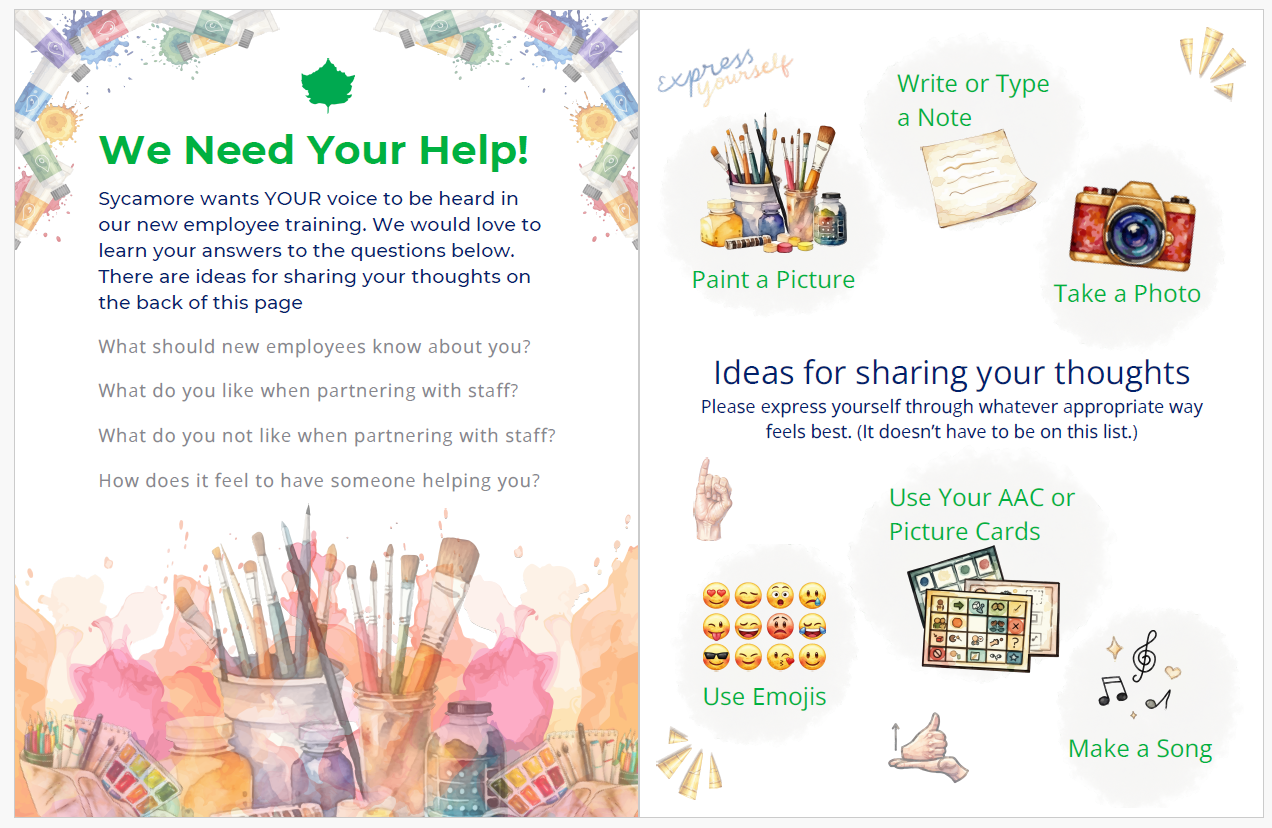
I also initiated an inclusive activity to glean input from the individuals served. The team had previously reported that their clients enjoy craft projects, so we leaned into that, while also providing several other methods for sharing their thoughts. (Many of these individuals are nonverbal and some have physical limitations as well.)
Design: System-wide Program Theme
The agency Director had a vision of their companywide training programs fitting into a theme. His initial suggestion was “roots and leaves”, since the agency is named after a tree.
I presented visual mockups for four nature-themed ideas and described how they could work across learning programs. The ideas were:
The team selected option #4 (The Ecosystem).
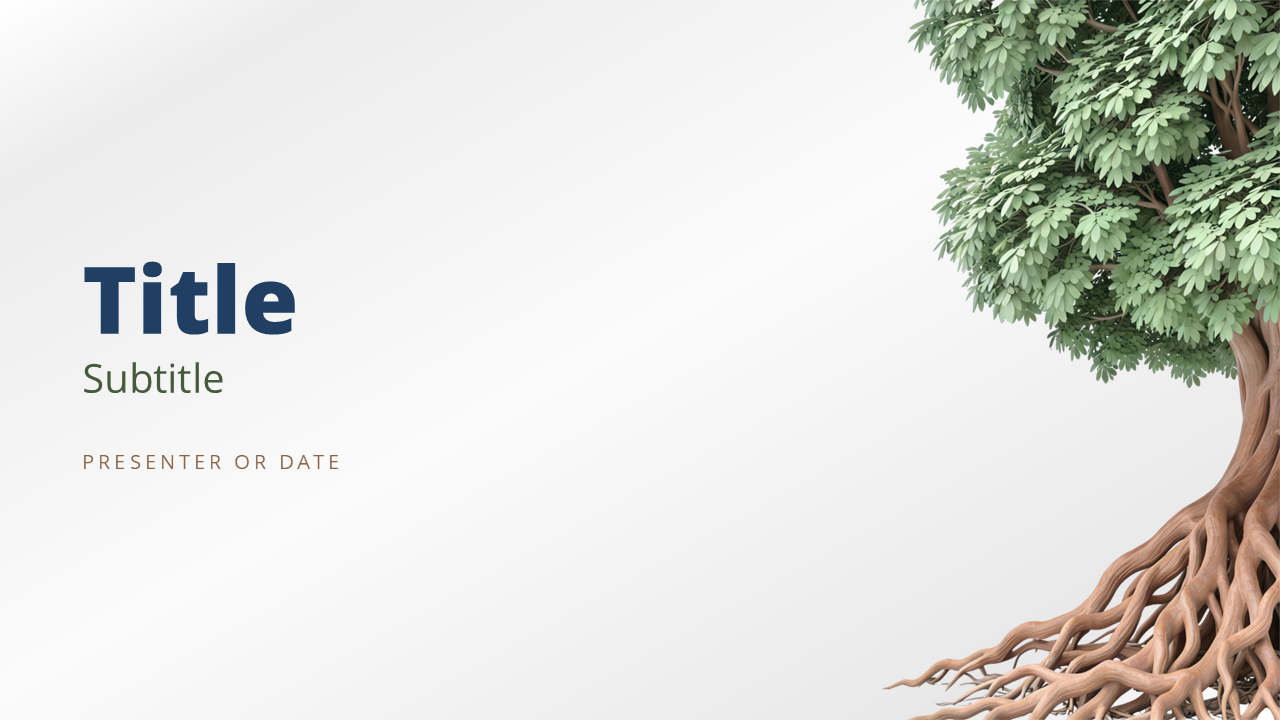
#1 - Roots and Leaves - The Director’s original idea made visual.
Onboarding = Roots
Annual Training = Leaves
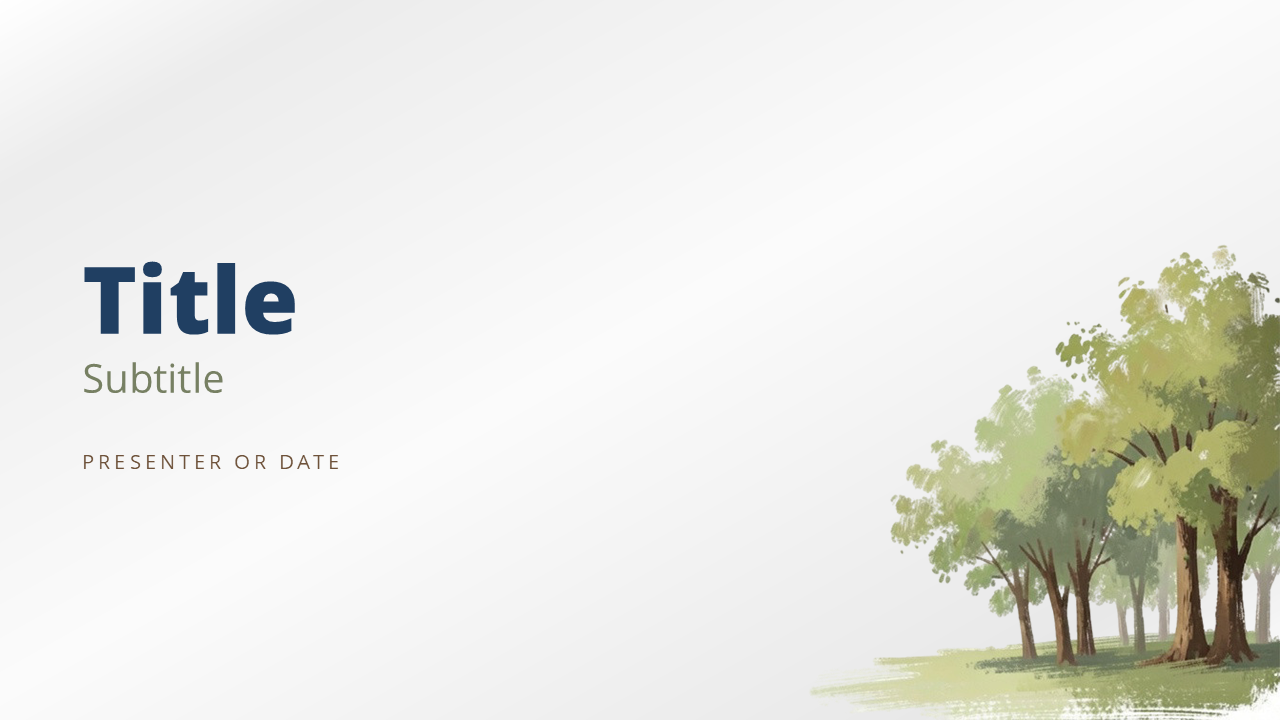
#2 - The Grove - A group of trees growing together are called a grove. This aligns with the message that staff are not expected to stand alone. Together, the team creates a grove of safety, comfort, and dignity for both the people they support and each other.
Onboarding = Roots
Annual Training = Seasonal Growth
Specialized Training = Grafting or Pruning
#3 - The Sapling to Canopy Journey - A lens of tree development stages that lead to staff member success. A focus on potential, patience, and scaffolding.
Onboarding = Sapling Stage
Annual Training = Adding Growth Rings
Specialized Training = Branching Out
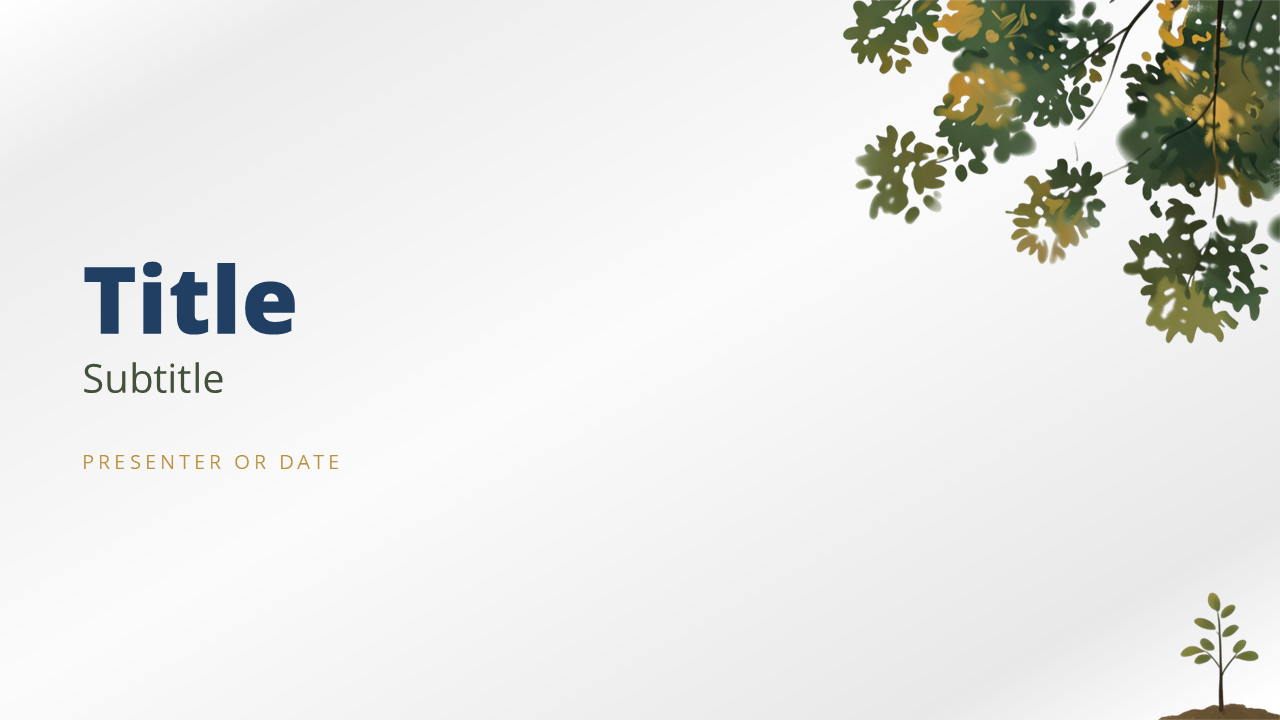
#4 - The Ecosystem - The staff member is the tree and the agency is the ecosystem. A tree is a vital resource for everything around it and provides important shelter, nourishment, and stability within the ecosystem.
Onboarding = The Forest Floor
Annual Training = The Seasons
Specialized Training = The Resources
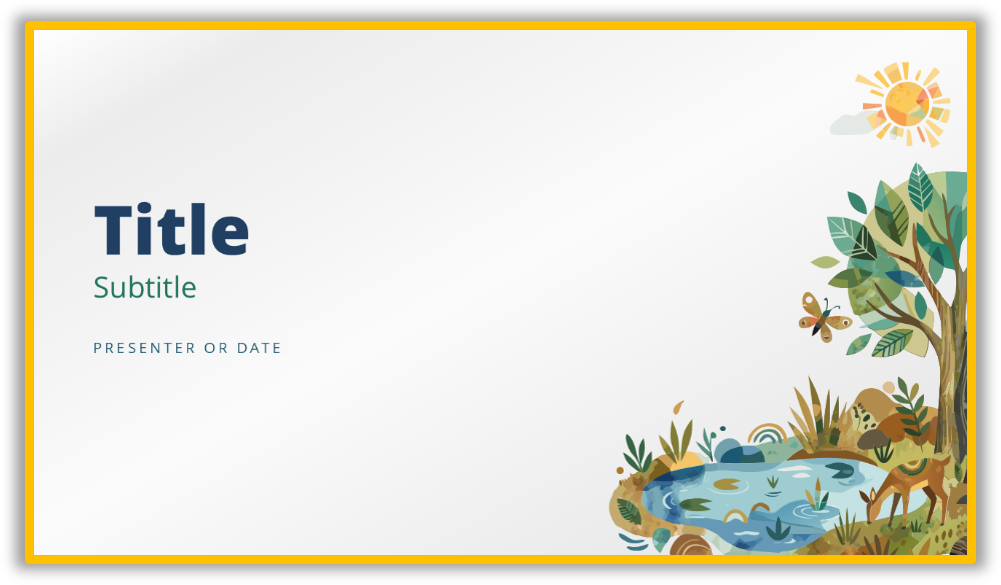
The agency chose #4 (The Ecosystem).
Design: Strategies
To accommodate a diverse learner population and support knowledge retention across compliance and core competencies, the curriculum incorporates the following instructional design strategies:
Stakeholder Inclusion: Embedded perspectives of individuals served and active participation into the training structure to align directly with CARF feedback and input standards.
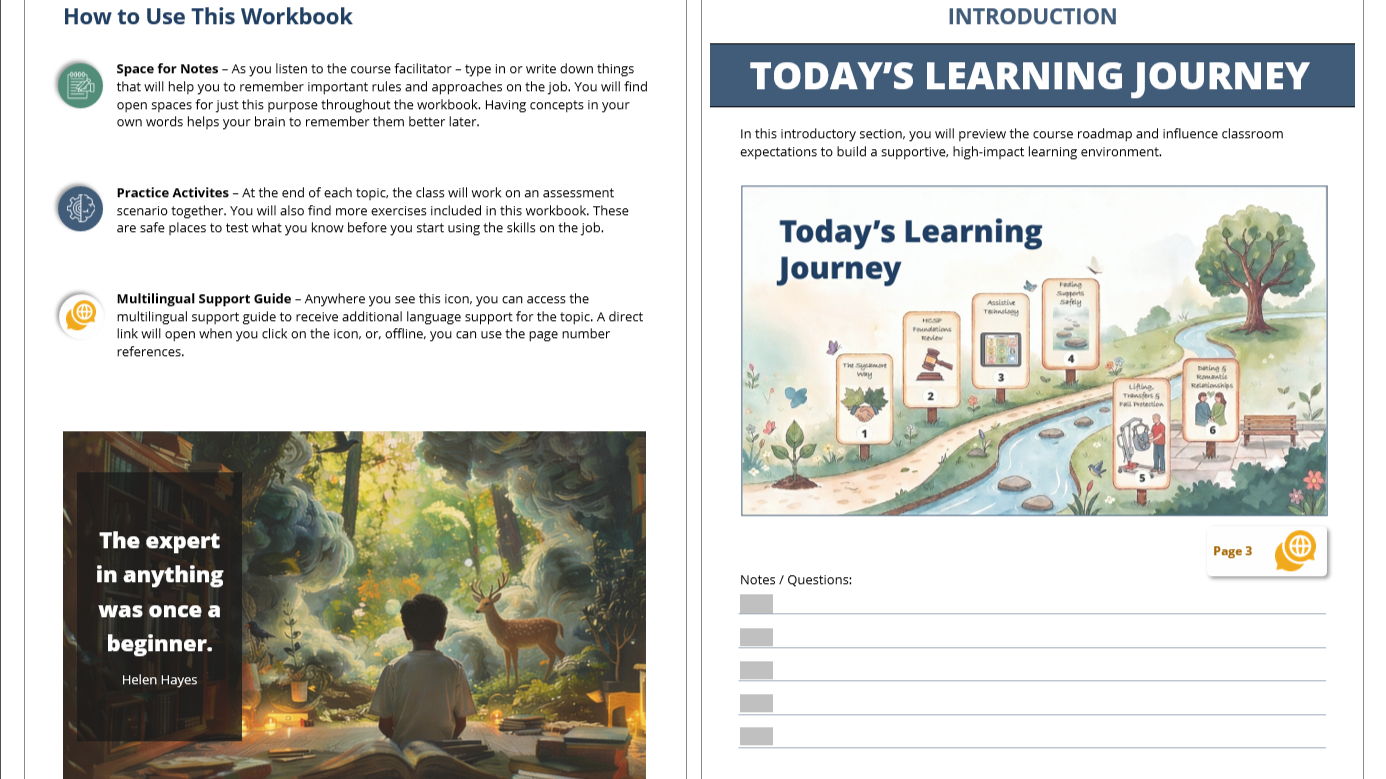
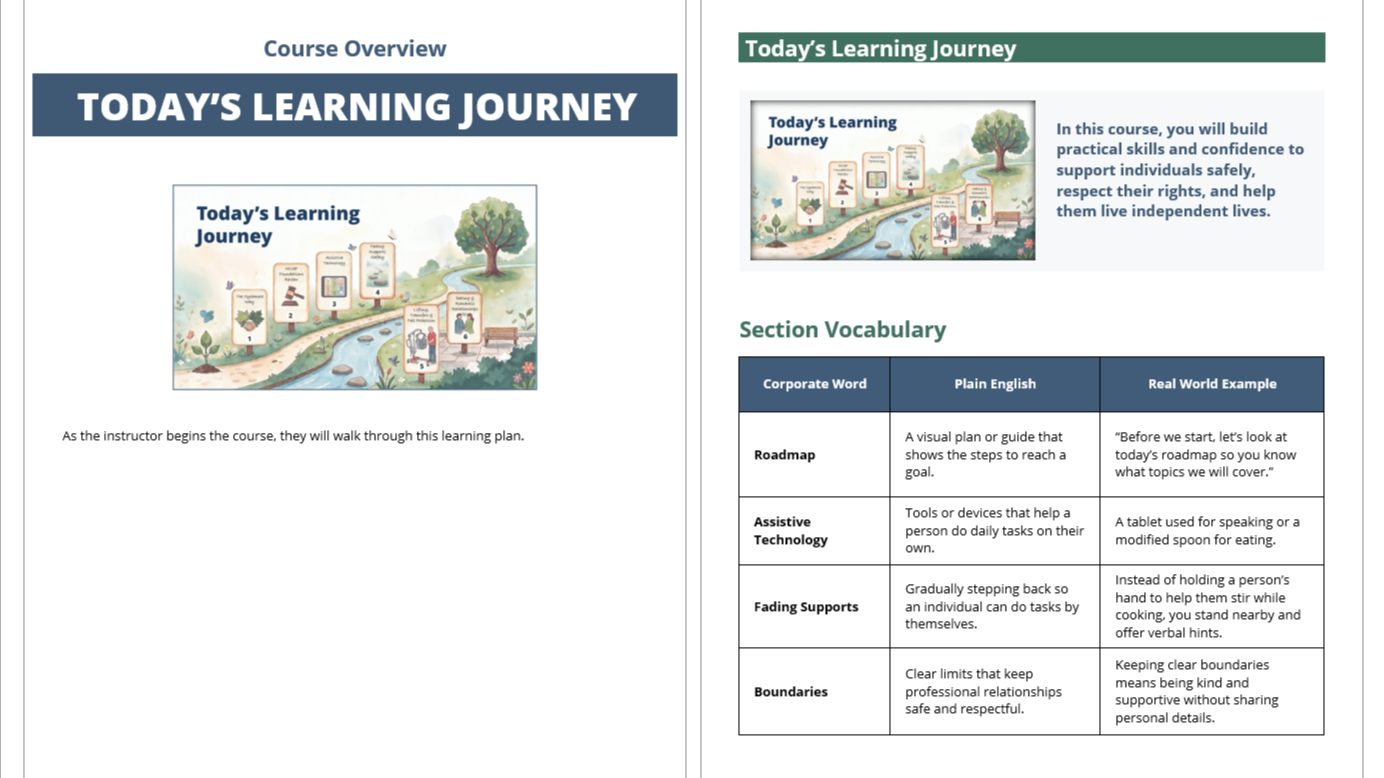
Visual Anchoring & Custom Graphics: Designed recurring character icons to serve as visual anchors for repeated concepts, and developed custom infographics to introduce and review key certification topics.
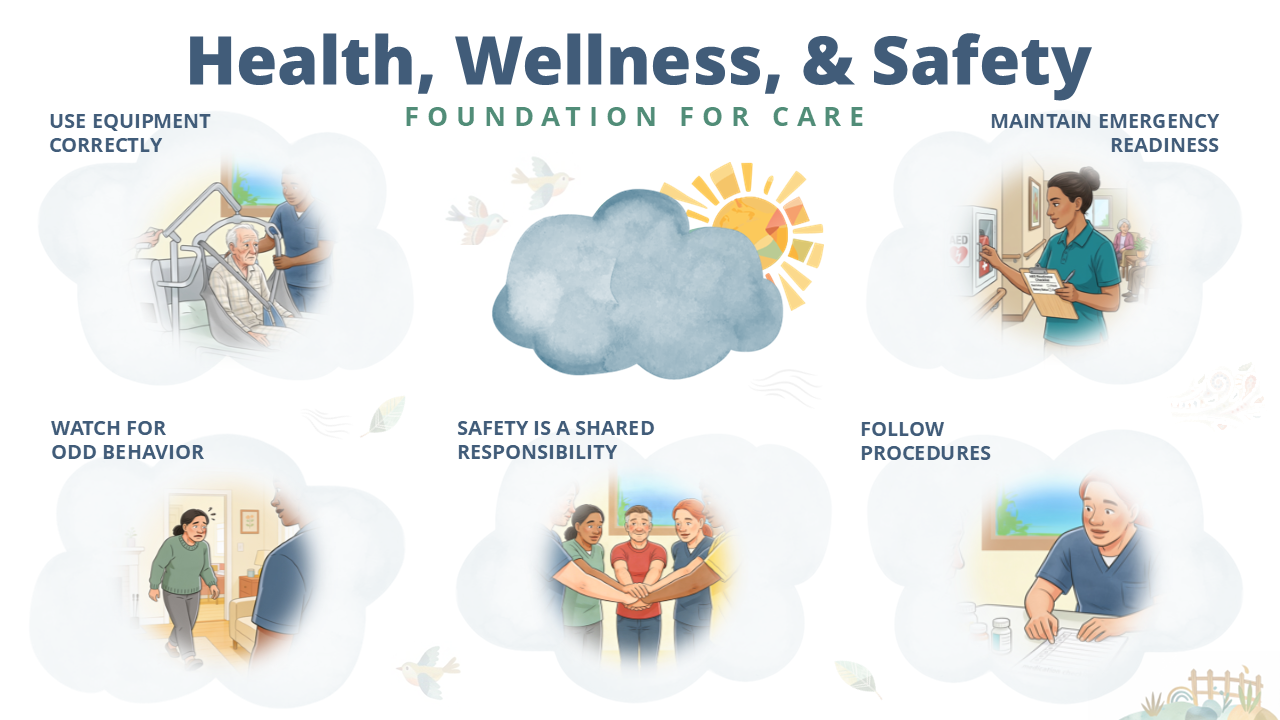
Anchor Introduction
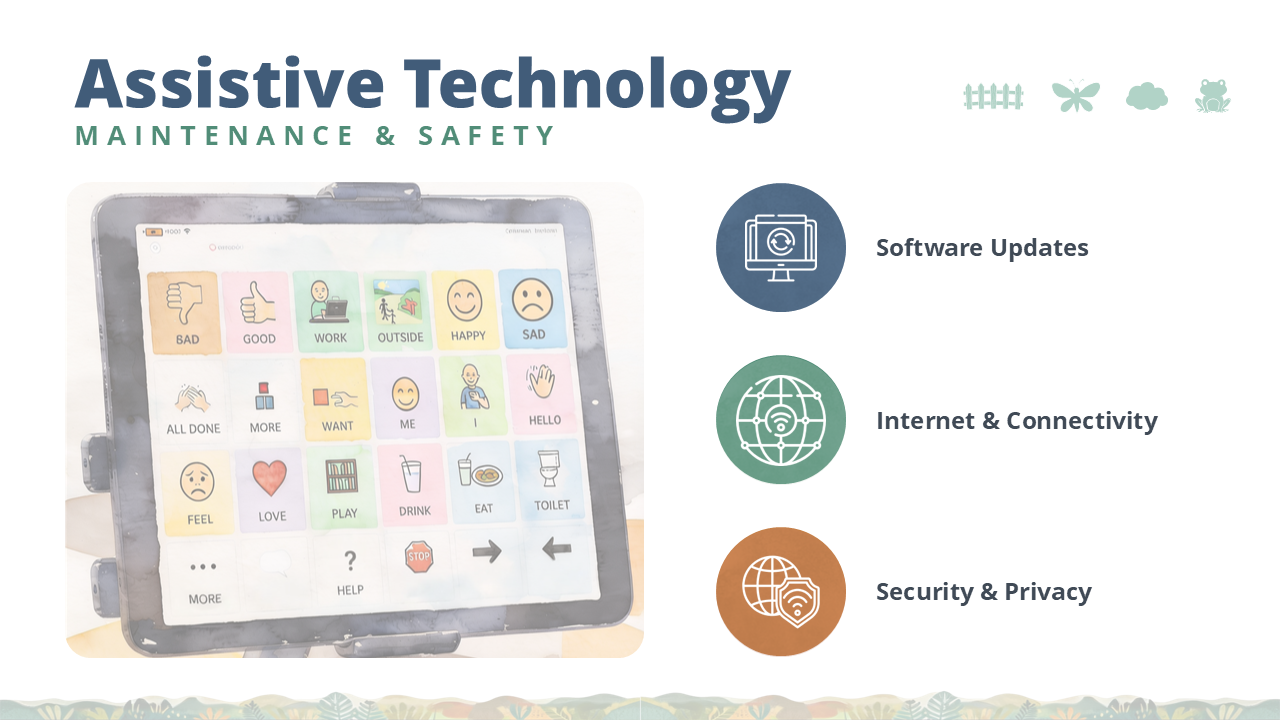
Anchor Use
Multimodal & Navigational Scaffolding: Paired visual support with plain-language frameworks to accommodate diverse reading levels and English Language Learners (ELL).
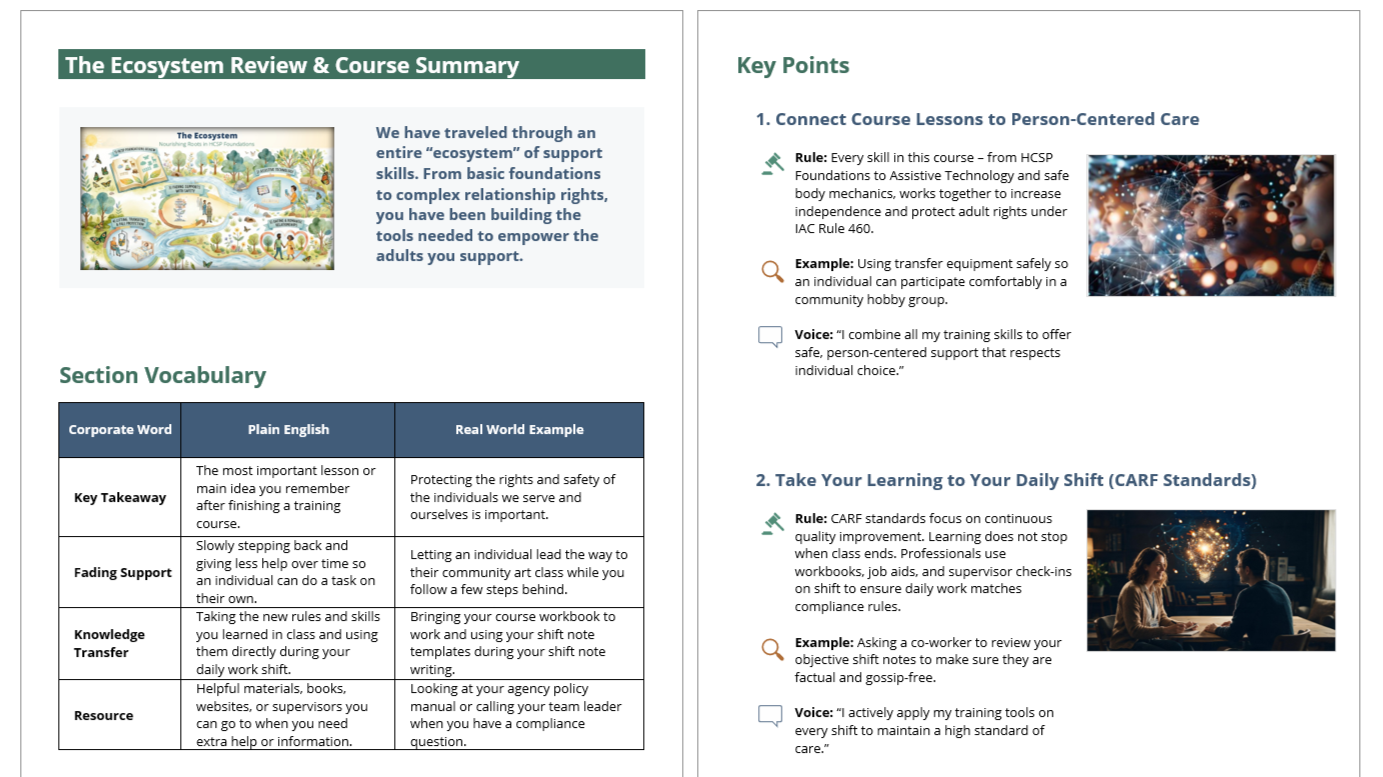
Embedded bi-directional page links between the Learner Workbook and ELL Support Guide to reduce cognitive friction and allow non-native English speakers to seamlessly access plain-language definitions and visual vocabulary without interrupting their learning flow.
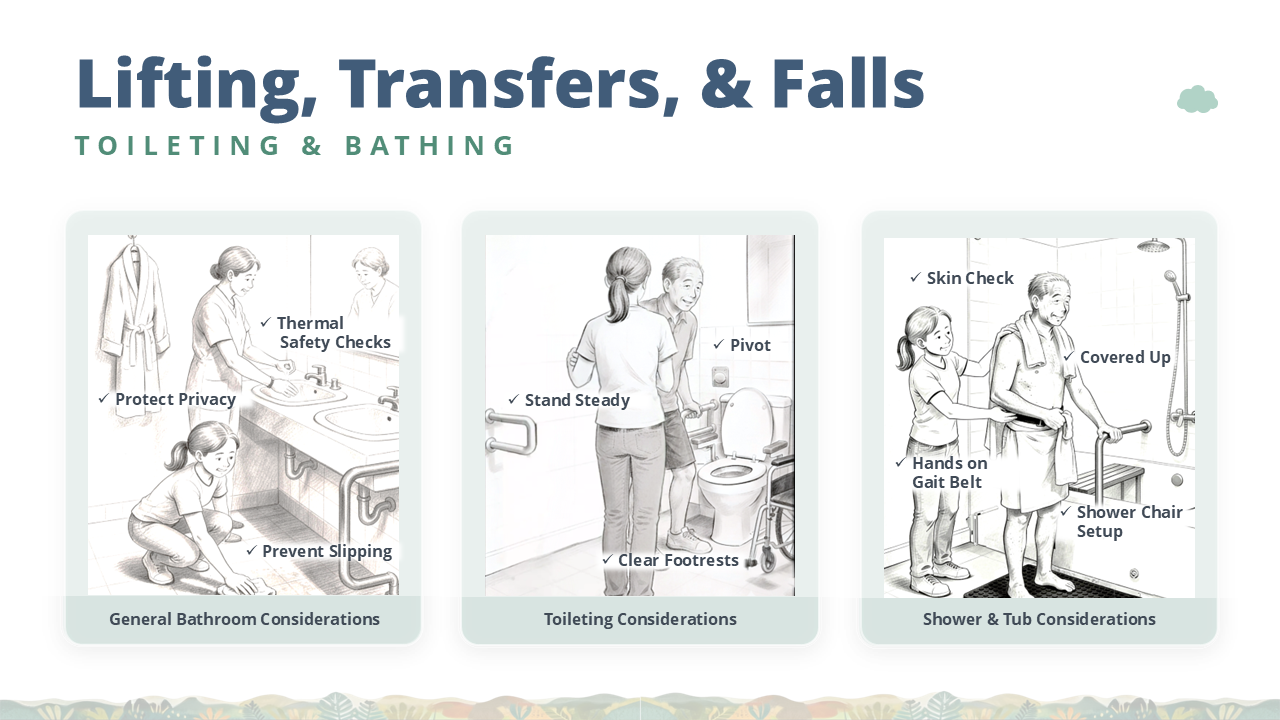
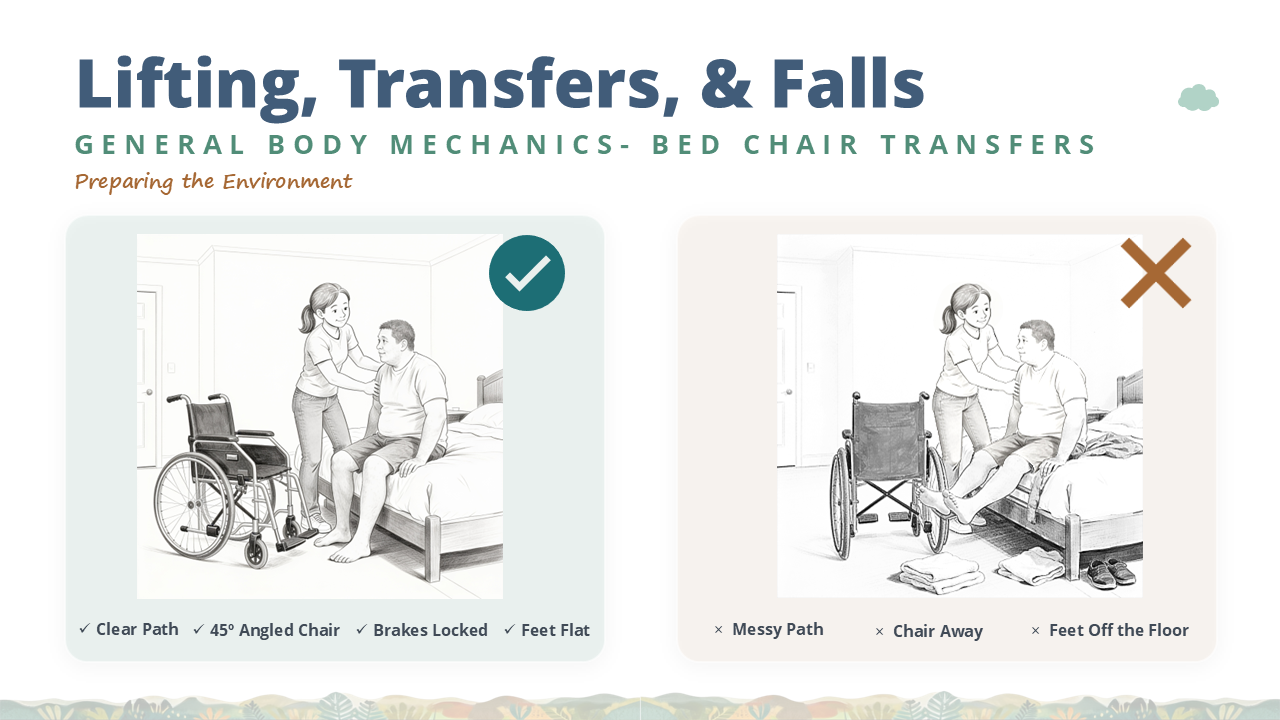
Behavioral Modeling: Utilized visual examples and contrastive modeling (showing both correct and incorrect techniques) to reinforce proper body mechanics and safety protocols.
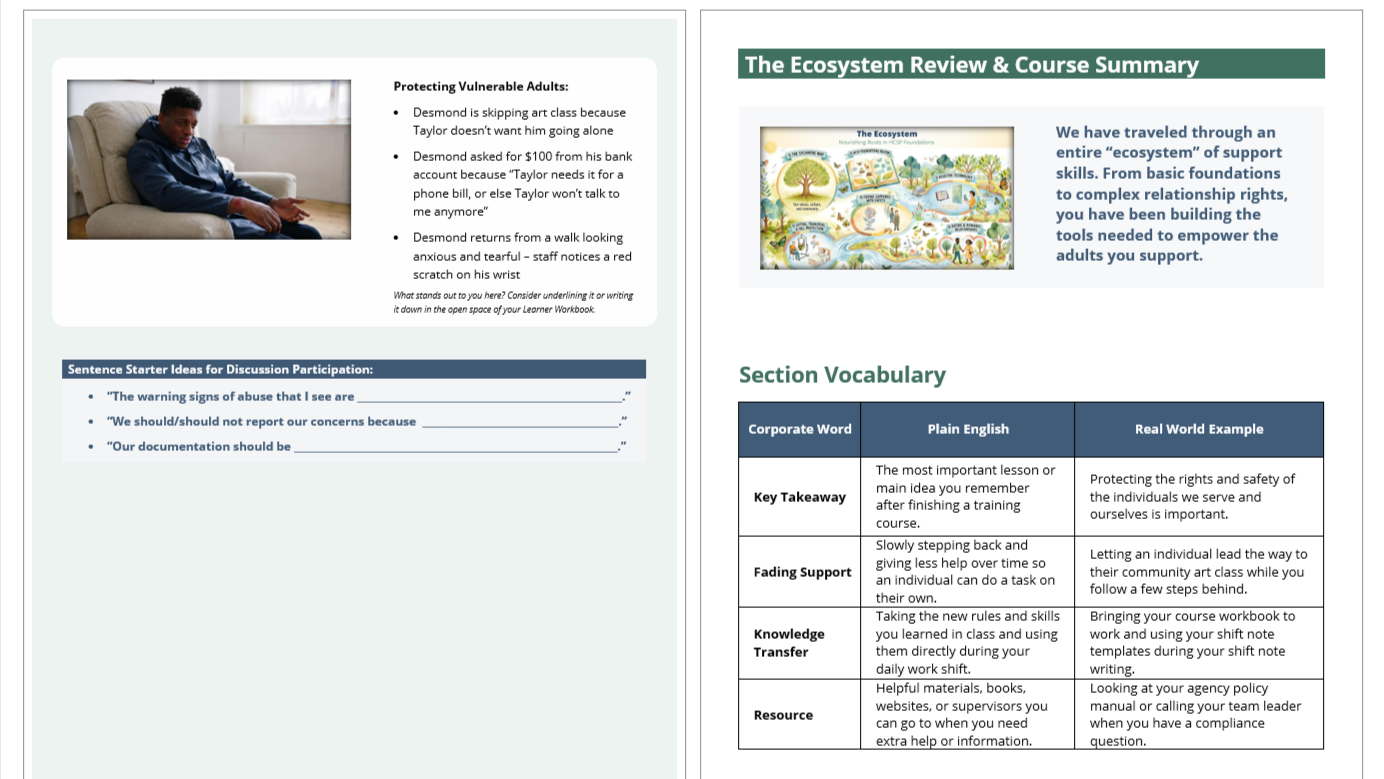
Varied Formative Assessments: Designed active, low-stakes practice to measure comprehension and increase engagement — including real-world scenario sandboxes, interactive trivia, “spot-the-issue” exercises, hands-on body mechanics practice (with mannequins), and guided workbook activities.

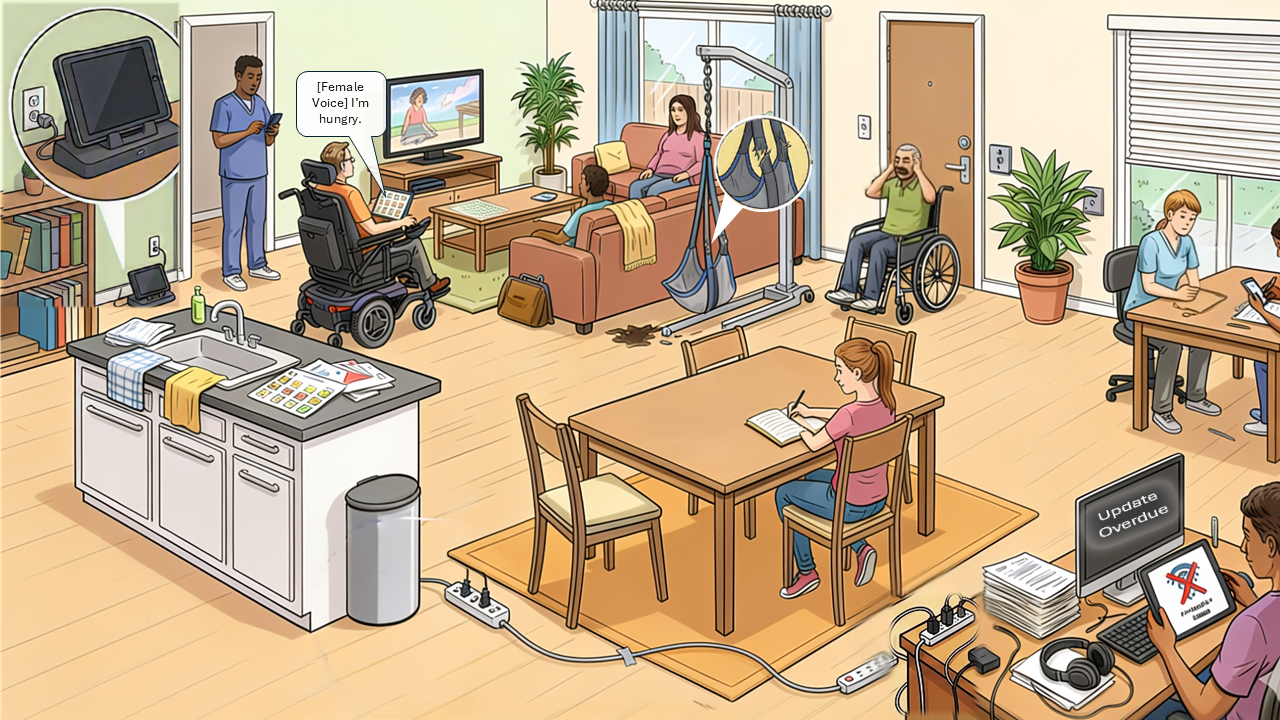
Find the 10 Assistive Technology issues.
Accessibility
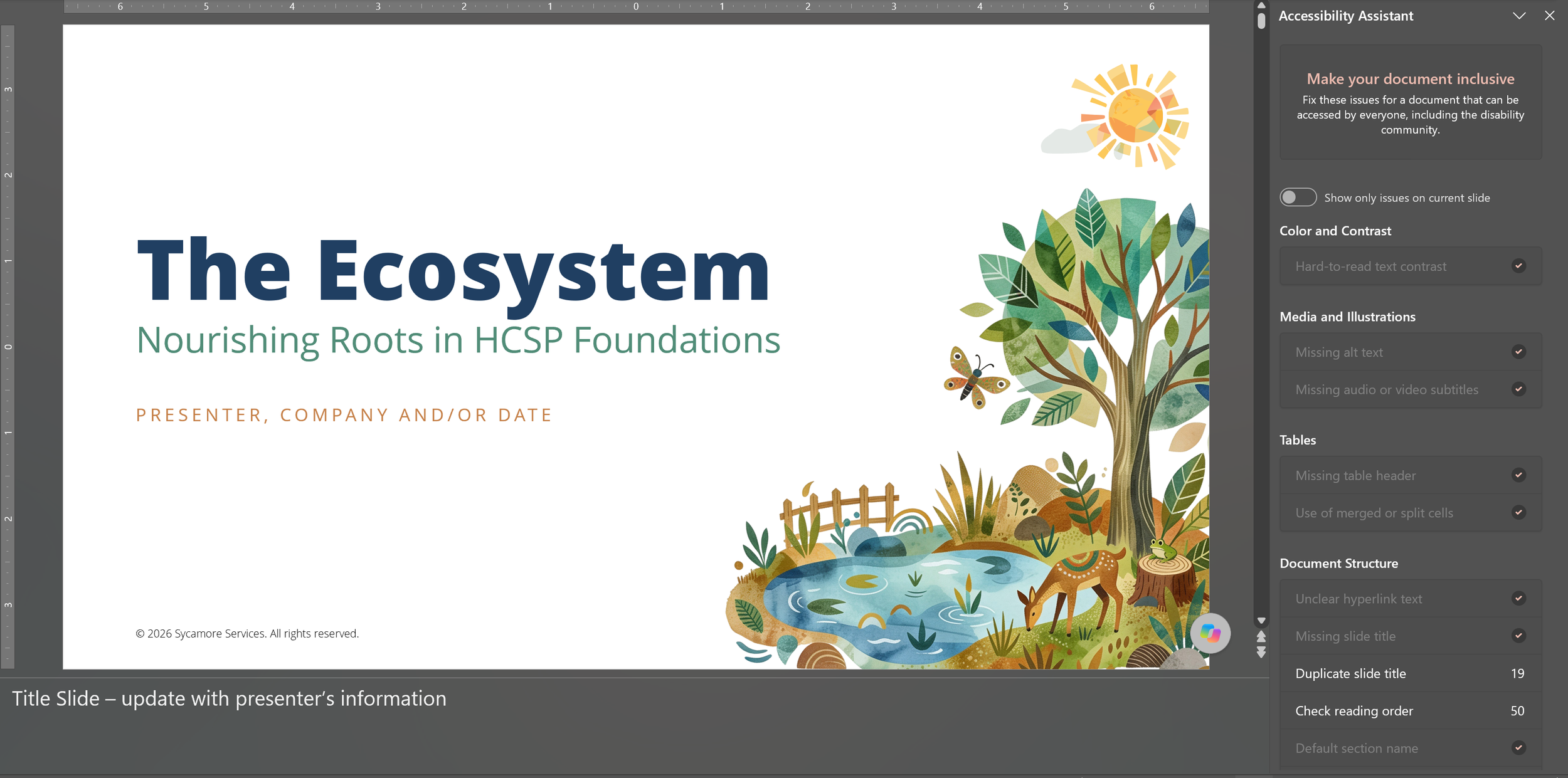
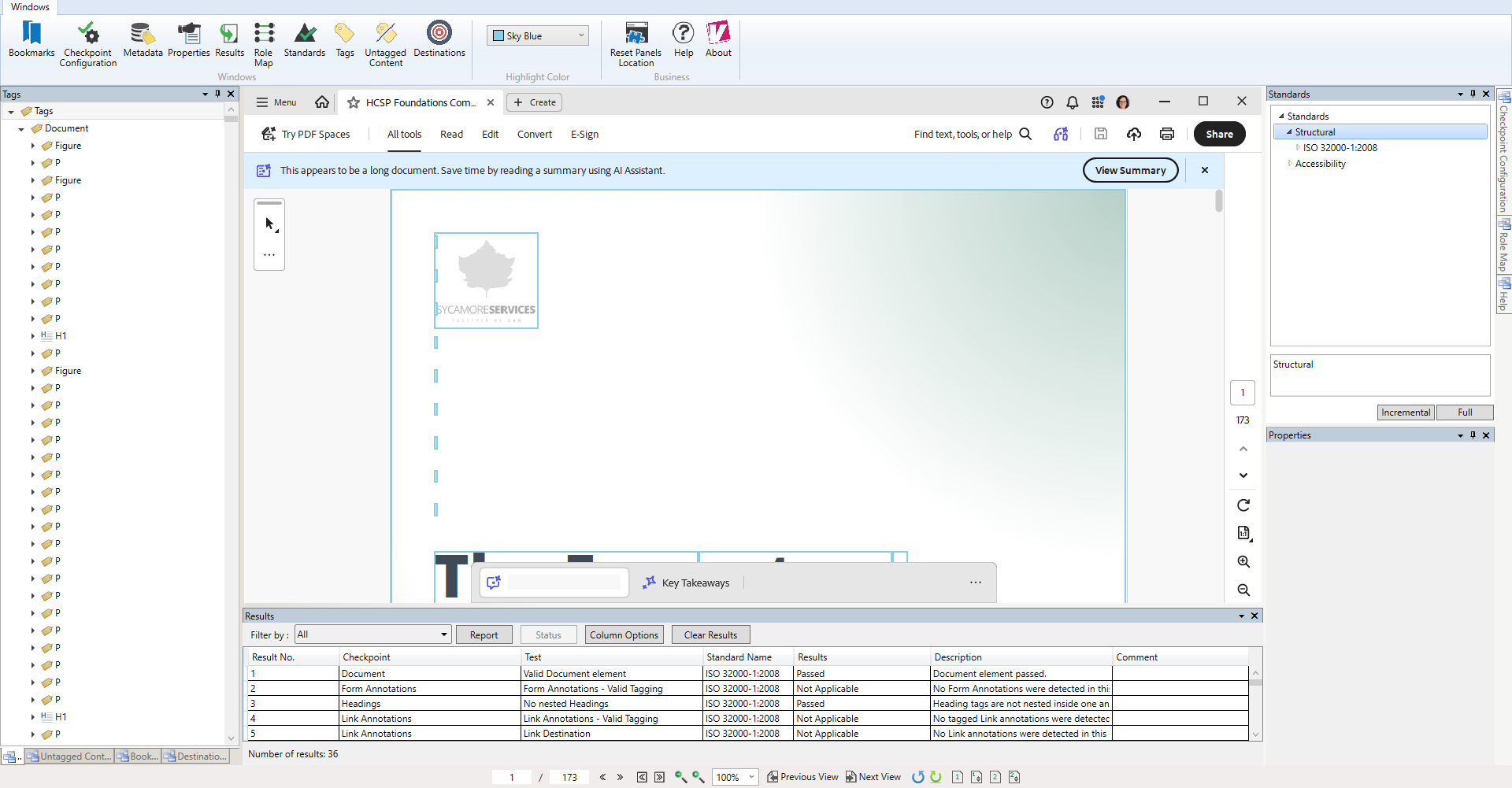
Using both CommonLook and Microsoft’s embedded Accessibility tools (Color and Contrast, Media and Illustrations, Tables, Document Structure, and Document Access), I ensured WCAG accessibility.
Deliverables
The agency needed two versions of the program, one for an internal audience and one for an external audience (so it could be monetized), so the curriculum was delivered through eight integrated assets, each intentionally designed to support active learning, consistent instructor facilitation, and learner accessibility.
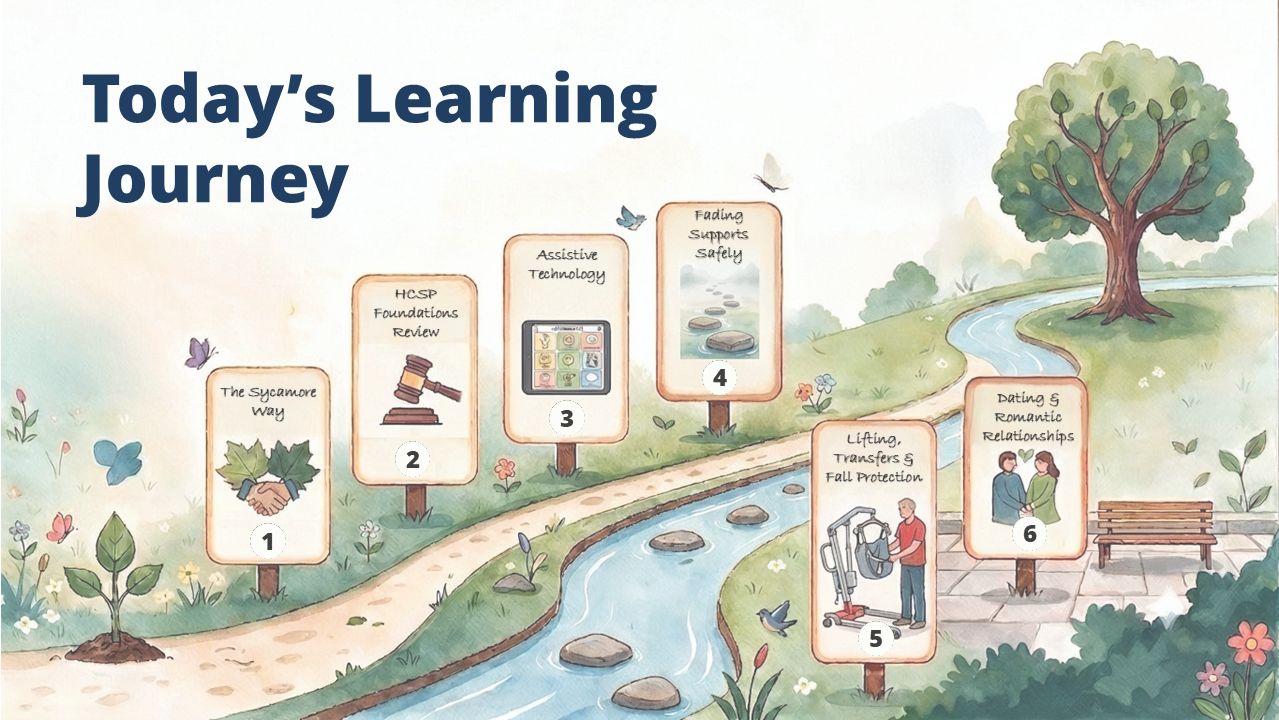
Presentation Deck (internal): Interactive visual instruction and the classroom anchor for the client agency.
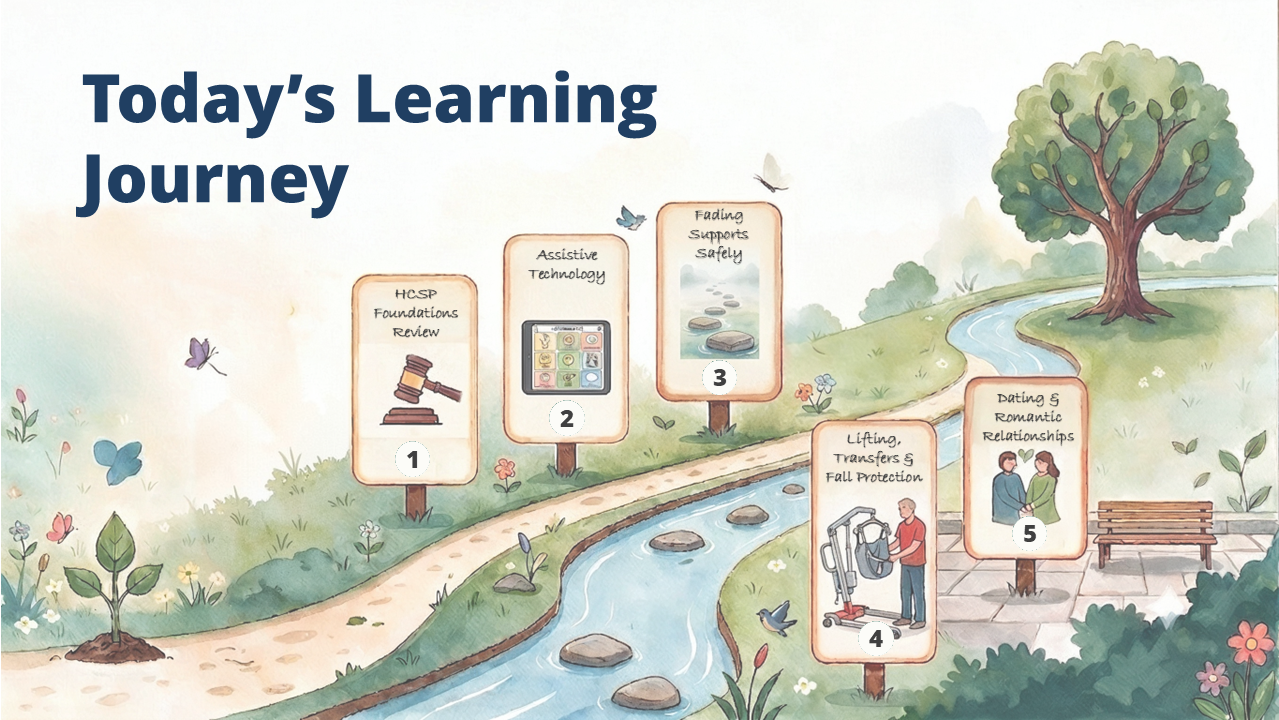
Presentation Deck (external): Interactive visual instruction and the classroom anchor for other DDAs.
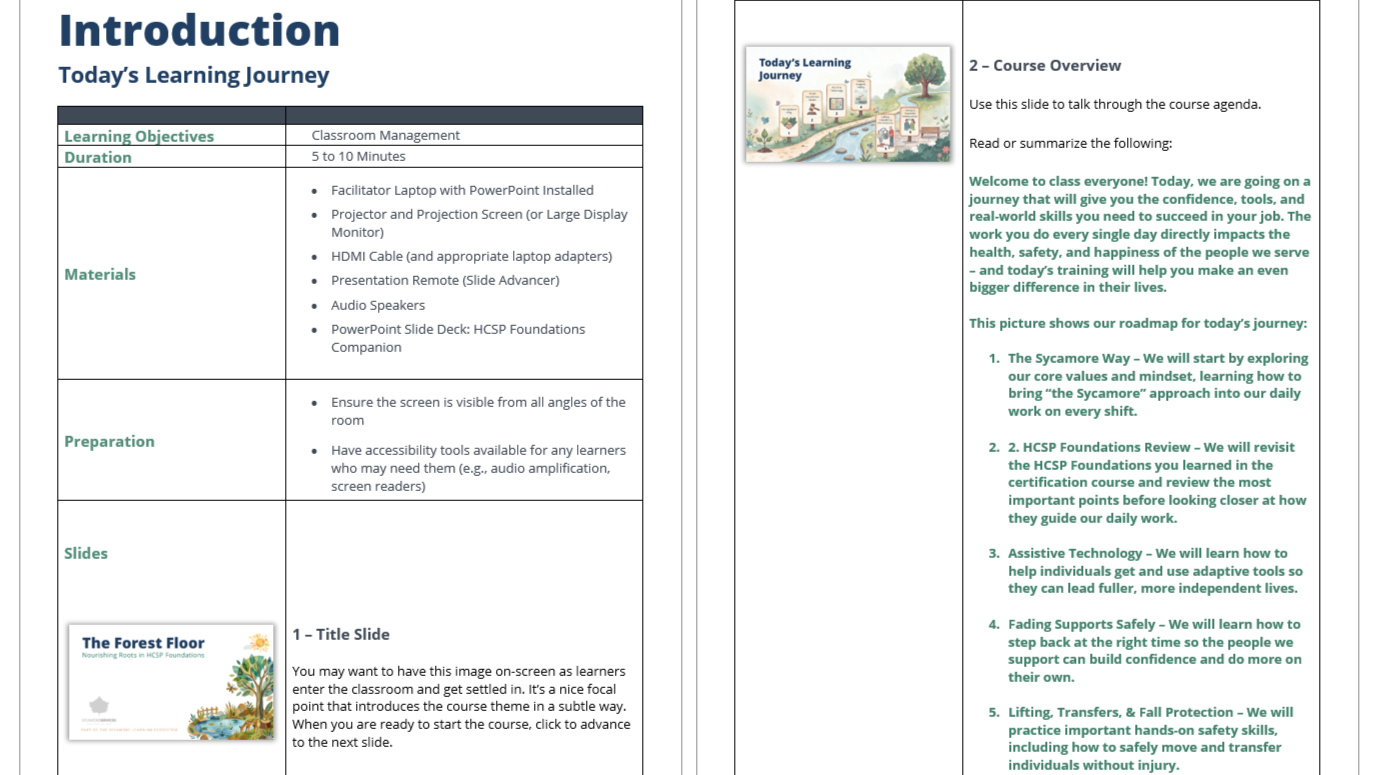
Facilitator Guide (internal): Provides instructor scaffolding, best practices, timing, materials, and discussion prompts for the client agency.
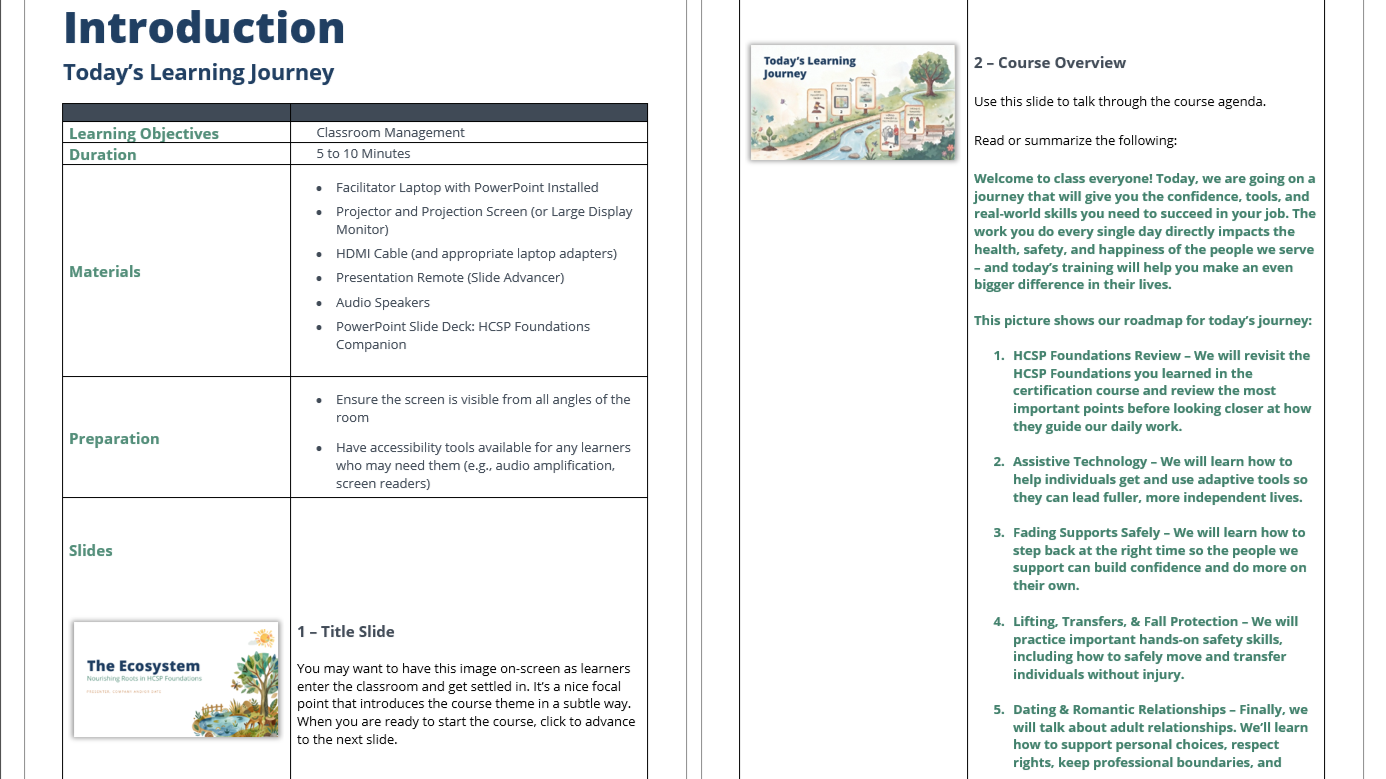
Facilitator Guide (external): Provides instructor scaffolding, best practices, timing, materials, and discussion prompts for other DDAs.
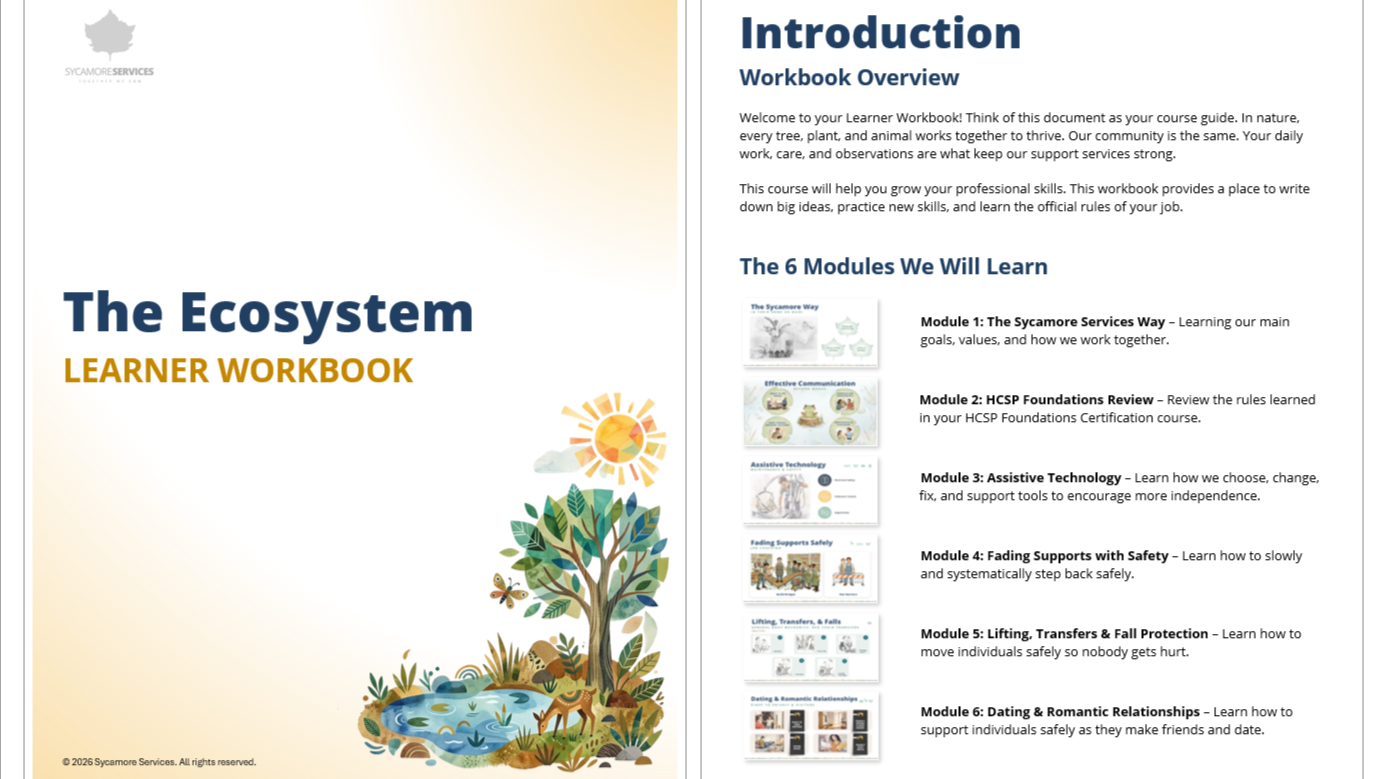
Learner Workbook (internal): Formative checks, scenario sandboxes, and reflection activities for the client agency.
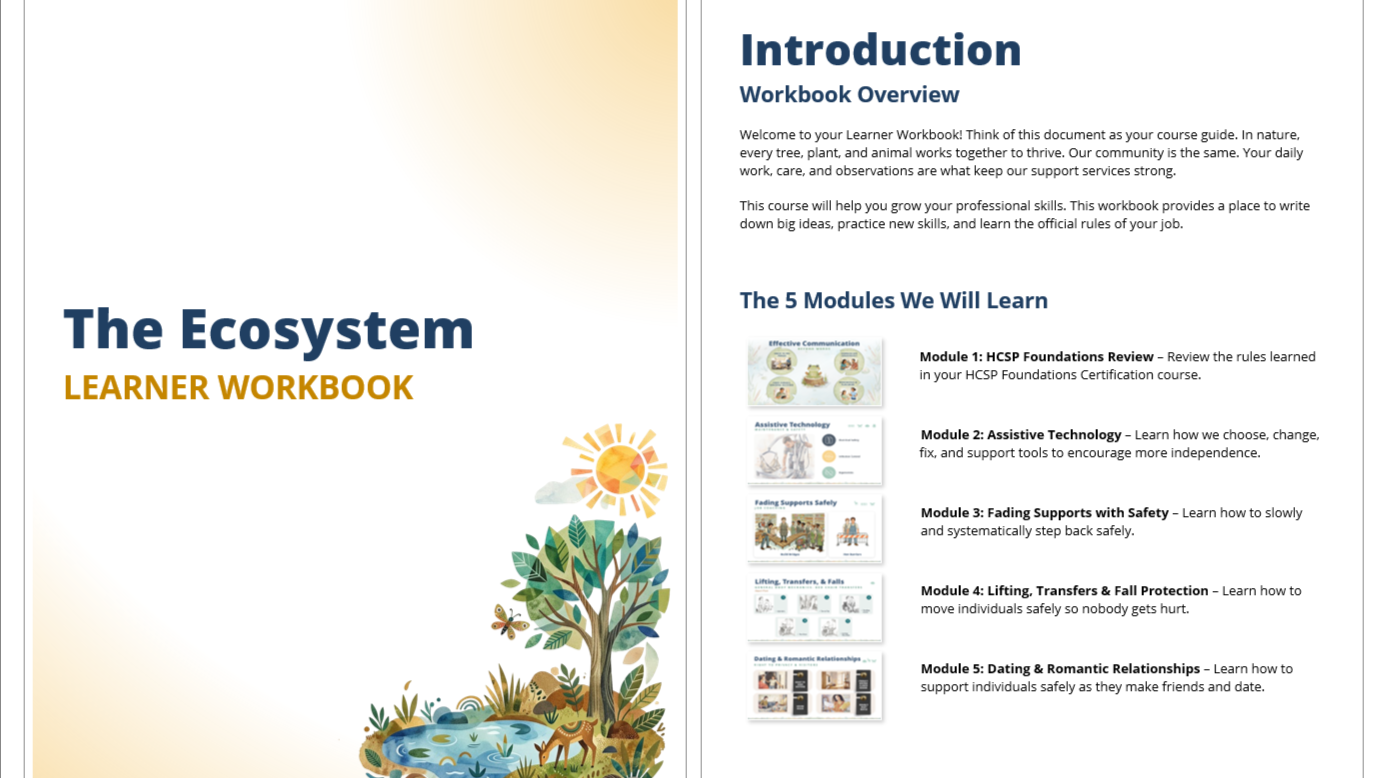
Learner Workbook (external): Formative checks, scenario sandboxes, and reflection activities for other DDAs.
ELL Support Guide (internal): Plain-language glossaries, visual vocabulary, and structured sentence frames for the client agency.
ELL Support Guide (external): Plain-language glossaries, visual vocabulary, and structured sentence frames for other DDAs.
Skills Used
PowerPoint
Magnific
Movavi Video Suite
CommonLook
Microsoft Word
Behavioral Performance Support
Narrative Case Studies
Documentation
Project Management
Monetization
Universal Design for Learning (UDL)
Accessibility Standards (WCAG)
Regulatory Compliance (IAC Rule 460, CARF)
Compliance Mapping
Contrastive Modeling