

YWCA Job Search Education Project
Snapshot
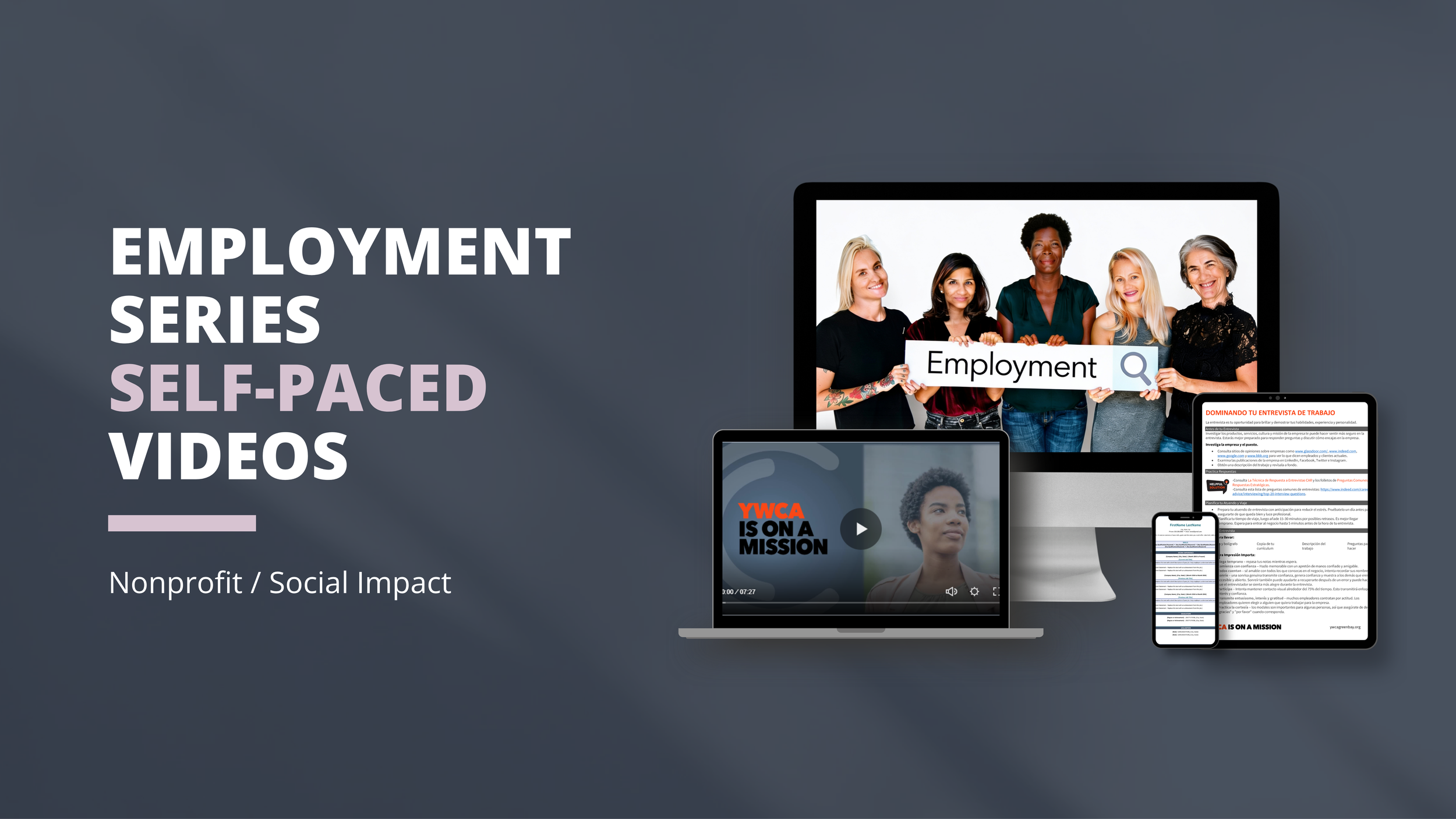
In collaboration with Paula Christensen of Strategic Career Coaches (the project SME), I developed a 3-video employment series for YWCA Greater Green Bay’s “Women Empowerment Center”, as part of a grant provided by AT&T. This was a 2+ month project with a small budget. I met with YWCA personnel, learners, and the SME.
As one of my first solo instructional design projects, my ID skills were just developing at this time. I like to include this case study because it shows my capabilities with trauma-informed pedagogy, empathetic design, and an ability to adapt learning theory around unique client situations.
Click to start video
Click to start video
Challenge: Build educational job search videos that align with grant-requirements and can help women, with highly varied backgrounds and interests, to secure meaningful employment.
Audience: Women ranging in age, education, race, ethnicity, religion, cultures, and life situations. Some audience members were experiencing trauma, homelessness, and/or mental health challenges.
Strategy: Trauma-informed pedagogy integrated with UDL — prioritizing safety, predictability, relatability, and flexibility throughout this learner experience. Lessons were delivered in both English and Spanish via videos (so they could be easily accessed at a library, at the YWCA location, or from home for those fortunate enough to have a computer and Internet).
At this stage, the client did not want learner tracking or program data collected and instead wanted learners to be able to stop/start and revisit content as often as necessary.
Eventually, I persuaded the client to collect some program data via pre-course and post-course surveys, so they could prove efficacy (for additional grants and program refinements).
Impact: The women utilizing YWCA services learned modern job search skills and best practices that enabled them to secure meaningful employment.
Process
The organization had a very small budget for this project and didn’t want to burden their program participants with shadowing or in-depth interviews. The analysis phase was limited to a single interview with a target learner, a brief meeting with the SME and YWCA Director, and my own research. Despite these limitations, I was able to effectively analyze the need and audience well enough to confidently deliver on the learning goals.
Analysis Phase


The instructional problem was defined, and the learning objectives were determined:
Learners will successfully create a viable resume for their position of choice.
Learners will execute a fruitful job search using common methods (e.g., applications, job boards, networking) that leads to at least one interview.
Learners will present themselves as a prepared professional in employment interviews.
The client did not want assessments within the learning solution, instead relying upon YWCA staff follow-up with each learner to evaluate transfer and any additional training needs.
I developed and considered several provisional personas throughout development, including:
Isabel — a married, Spanish-speaking mother of four who will be pursuing retail positions
Denise — an English-speaking, formerly incarcerated grandmother with some college experience and about five years left until retirement age
Fatimah — a young abuse survivor from a Middle Eastern culture, who has never been employed and is battling limiting beliefs about women and employment
The team participated in two ideation sessions that generated the video series solution, the need for a graphic that shows the series order within each video, and the desire for a lead-in slide that showcased the YWCA mission.
The project SME and I produced outlines of the appropriate content for this learner group and learning objectives. The organization provided their Brand Standards and, based on their required colors and fonts, I prepared a project Style Guide in Figma.
Design Phase

I then created and presented multiple design mockups for consideration. It was important to utilize colors that complemented the brand’s bright orange color.


The team selected the blue option and its proposed layout.
A storyboard was created in PowerPoint for each video and then uploaded into Google Slides. The SME reviewed these files online and noted requested changes.
Development Phase

PowerPoint slideshows were created from the storyboards, covering all content for the 3 main videos. Artificial Intelligence (AI)-generated narration clips were created in Speechify and incorporated into PowerPoint in order to coordinate animations and audio timing.
Please note the audio clips were created in 2023 and AI voiceovers were not as polished at that time.


The final slideshow videos were exported from PowerPoint into Movavi, where background music and unique transitions were added.

All slide text and audio scripts were translated into Spanish with the help of Google Translate, Bard (now Gemini), and a native Spanish-speaking connection (to confirm accuracy). Translated narration was then re-recorded (via AI voiceover) in Spanish and these versions were set to background music in Movavi.
Unfortunately, the organization’s small budget did not cover hours for usability testing, so this step had to be skipped over.
The videos were delivered electronically to YWCA ahead of the project deadline. The organization began using them as part of their Women’s Empowerment Center services in Fall 2023. I was not involved in the implementation phase, based on the project budget and rollout simplicity.
Implementation Phase

Initially, the client did not want assessment as part of the project scope. Since the solution needed to be exclusively videos and handouts (no opportunity for formative assessments), I advised that we conduct surveys to ensure that:
1) learning goals were achieved,
2) future iterations of the content could leverage learner feedback, and
3) future grant requests could include efficacy data. With this insight, YWCA Green Bay decided to expand the scope.
Both English and Spanish learner surveys were created using Typeform. I developed a pre-survey, post-survey, and 60-day follow-up survey to assess video efficacy and long-term knowledge retention.
Early respondent feedback showed improvement in learners’ job search confidence. Additional insights will hopefully be gleaned as the Center uses the surveys over time.
Evaluation Phase

Skills Used
ADDIE Design Process
Curriculum Development
Assessments
Storyboarding
Style Guide
PowerPoint
Movavi Video Software
Figma
Adobe Photoshop
Adobe Illustrator
Job Aids / Handouts
Video Production
Video Editing
Language Translation
AI Voiceovers / Narration
Midjourney AI
Revoicer AI
Bard AI
Accessibility Standards